

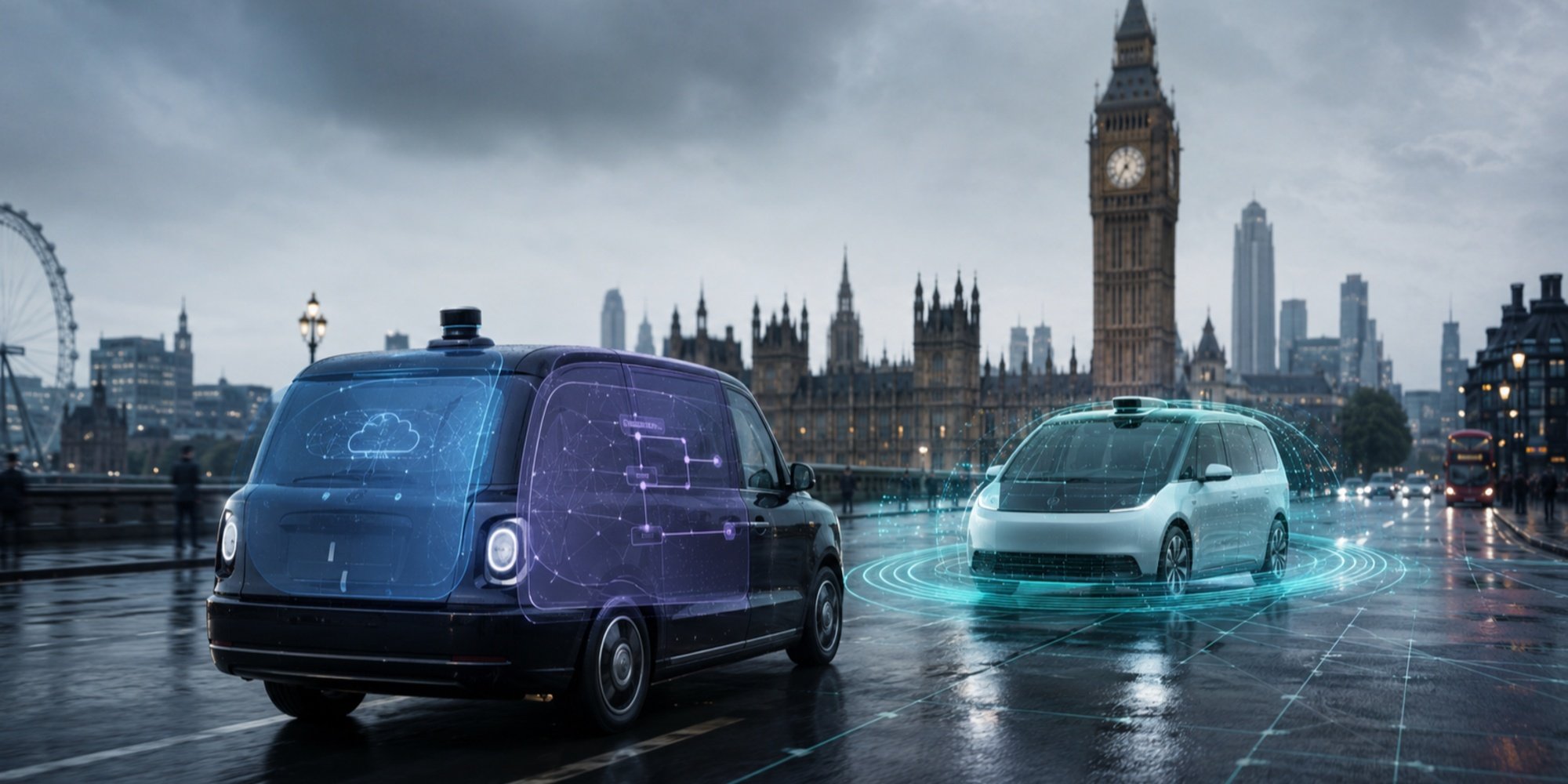
On June 8, 2026, according to The Verge, Uber opened an interest list for London customers who want to be matched with a robotaxi operated with Wayve, the London-based L4 autonomous driving startup. The chosen setup breaks with the American-style integrated robotaxi model: according to The Next Web, Uber owns and operates the fleet, while Wayve provides the software — the AI Driver — that actually drives the vehicles (with a safety operator on board). The split is explicit: a demand operator on one side, a software stack provider on the other, whereas Waymo brings both functions together under one roof. Wayve is still seeking UK government approval to put its autonomous minicabs on the road, and no official launch date has been confirmed to date. The fleet/software split highlighted on the London side is thus accompanied by an equity entanglement that neither partner has publicly quantified.
Two models converge on the same city
On the same London turf, Waymo, Alphabet’s subsidiary, is preparing a commercial launch for 2026, with its vehicles having been tested there for several months according to TechCrunch. Also according to TechCrunch, both camps are targeting London as the first European market for their robotaxi service, which would put the British capital at the forefront of the European race to commercial deployment. Alphabet’s subsidiary has already launched several services in the United States, notably in Austin, Texas, where it operates its own end-to-end service — fleet, software and app — without an intermediary. The contrast with the Uber-Wayve tandem is clear from an industrial standpoint: on one side, a vertically integrated player controlling the customer experience; on the other, a division of roles between a demand operator and an AI Driver provider. The comparison remains prospective, however. As of June 8, 2026, neither side had obtained UK government authorization to run a commercial service, and no official launch date had been confirmed.
When the customer becomes a shareholder
The line between operator and provider is not watertight when it comes to capital. According to Wayve’s press release published in February 2026, the startup raised $1.5 billion in Series D at an $8.6 billion post-money valuation, with participation from Microsoft, NVIDIA, Uber, as well as Mercedes-Benz, Nissan and Stellantis. Uber therefore appears both as an industrial customer — future operator of the London fleet, in a partnership sealed on June 10, 2025 for L4 public-road trials — and as a shareholder in its own software supplier. Uber has also committed additional capital tied to deployment milestones. The fleet/software split highlighted on the London side is thus accompanied by an equity entanglement that neither partner has publicly quantified. This setup recalls an earlier path: Uber sold its autonomous driving unit ATG to Aurora at the end of 2020, and its return today comes through an equity partnership rather than through reintegrating the technology layer.
In London, then, Uber is not replaying the ATG story. It is no longer trying to build the autonomous driver on its own, but rather to become the commercial and operational interface capable of aggregating several competing software stacks. Against Waymo, the duel is not only about vehicle performance: it pits two visions of the robotaxi value chain against each other.