

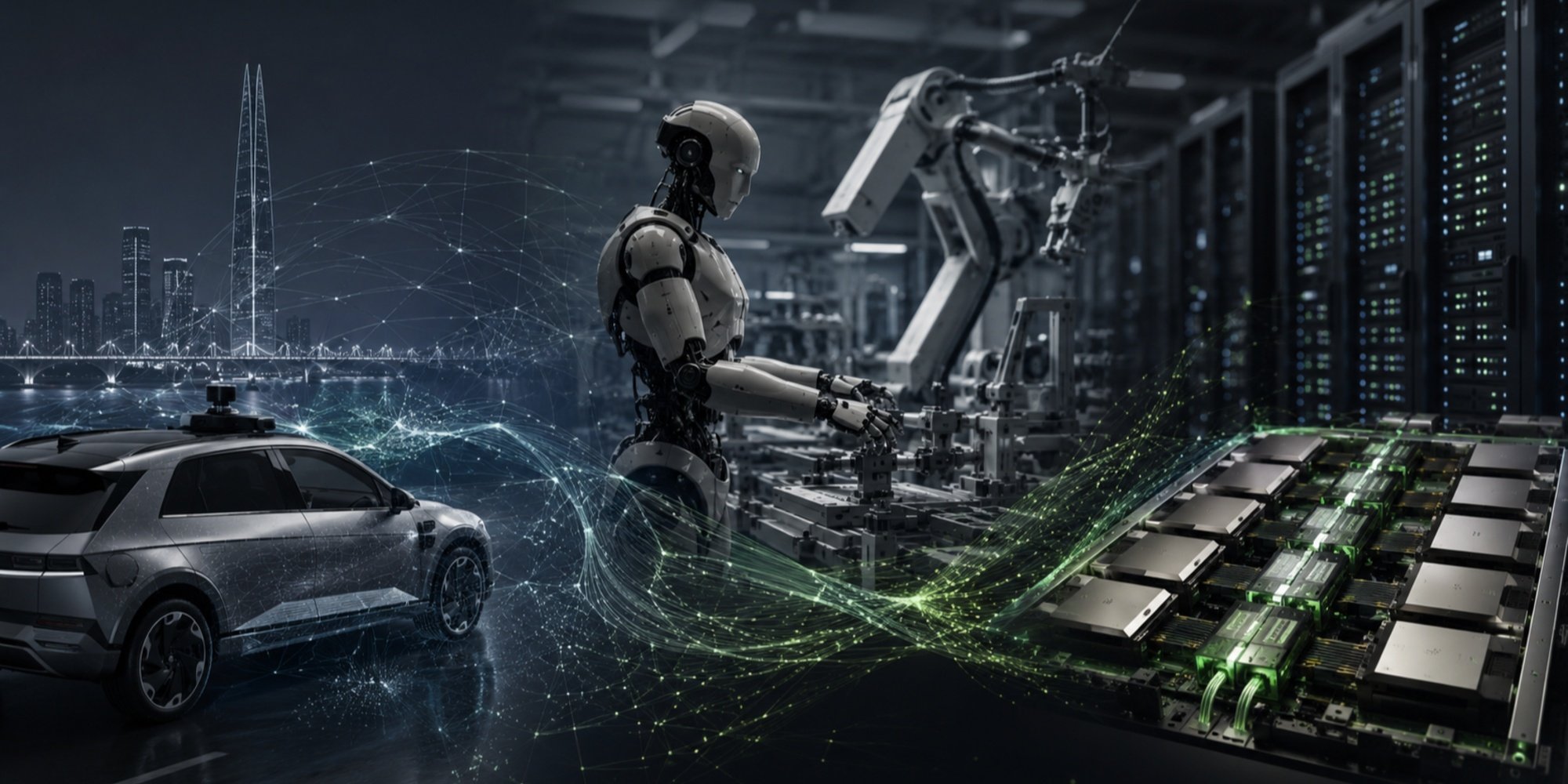
Nvidia and Hyundai Motor Group announced on June 8, 2026, at the conglomerate’s headquarters in Yangjae (Seoul), a new phase of cooperation built around three pillars: software-defined autonomous vehicles (SDV), humanoid robotics through the Boston Dynamics subsidiary, and an AI factory powered by Blackwell GPUs tied to the Saemangeum project. The same day, just a few kilometers away, LG and Nvidia simultaneously announced the M.A.P. partnership - Mobility, AI Infra, Physical AI - covering a largely parallel scope. In the same sequence, Jensen Huang sealed six agreements: Unitree on June 2, then SK Hynix, Naver, Doosan, Hyundai and LG during the Korean tour from June 5 to 8. This pattern is not an ordinary sales tour: the Android precedent is analytically close on three points - non-exclusive commercialization, permissive licensing, effective hardware dependency - but it differs on one crucial point: Google did not manufacture the silicon for Android, while Nvidia designs and sells the silicon that runs GR00T.
An open license, closed silicon
GR00T N1.7, a 3-billion-parameter VLA (Vision-Language-Action) model released as open-weight under an Apache 2.0 license by Nvidia, combines two layers: a Cosmos-Reason2-2B module that translates images and instructions into action intentions, and a 32-layer Diffusion Transformer that turns those intentions into real-time motor commands. The license allows forking, retraining and deployment without royalties. Inference performance, however, is tied to the Jetson Thor embedded module, which Nvidia credits with 2,070 FP4 TFLOPS, 128 GB of memory and 7.5 times the AI power of the previous AGX Orin. The FP4 format - a four-bit numerical representation - is currently fully exploited only on this silicon; the Omniverse training ecosystem, meanwhile, is anchored to CUDA. Nvidia’s developer page does not publish any third-party evaluation of GR00T N1.7 on real-world manufacturing tasks, and the documentation remains centered on simulation demos.
Hyundai, a test case with uncertain execution
Hyundai’s stated goal is 30,000 Atlas robots per year by 2028, in a new robotics plant near Savannah, Georgia - a target announced by the group at CES 2026 and not repeated by Nvidia in its June 8 press release. According to data released by Hyundai, more than 25,000 of these units would be allocated to the production lines of Hyundai and Kia, or 83% of the targeted capacity. Internal deployment is therefore the main outlet, and that is where execution becomes complicated: Axios reports that a union within the group challenged the introduction of the robots without prior social agreement, and official communications remain silent on the timeline for such an agreement. On the technical side, Boston Dynamics published a blog describing the learning of heavy-load carrying through internal force feedback rather than visual identification - a method that makes Atlas’s performance less dependent on the visual reasoning of a VLA model than the platform narrative suggests.
The platform’s scope: a segment, not an entire universe
Three major humanoid players remain outside Isaac: Tesla with Optimus, Figure AI and Apptronik are developing their own software stack and depend neither on GR00T N1.7 nor on Jetson Thor. The platform position documented by the Korean sequence therefore applies to a specific segment: established Asian manufacturers with strong vertical integration and a willingness to automate their own production. The Android precedent is analytically close on three points - non-exclusive commercialization, permissive licensing, effective hardware dependency - but it differs on one: Google did not manufacture Android’s silicon, whereas Nvidia designs and sells the silicon that runs GR00T. The readable signal today is limited in scope: Nvidia occupies a platform-supplier position in Korea’s physical AI industry, not across the entire humanoid market.