

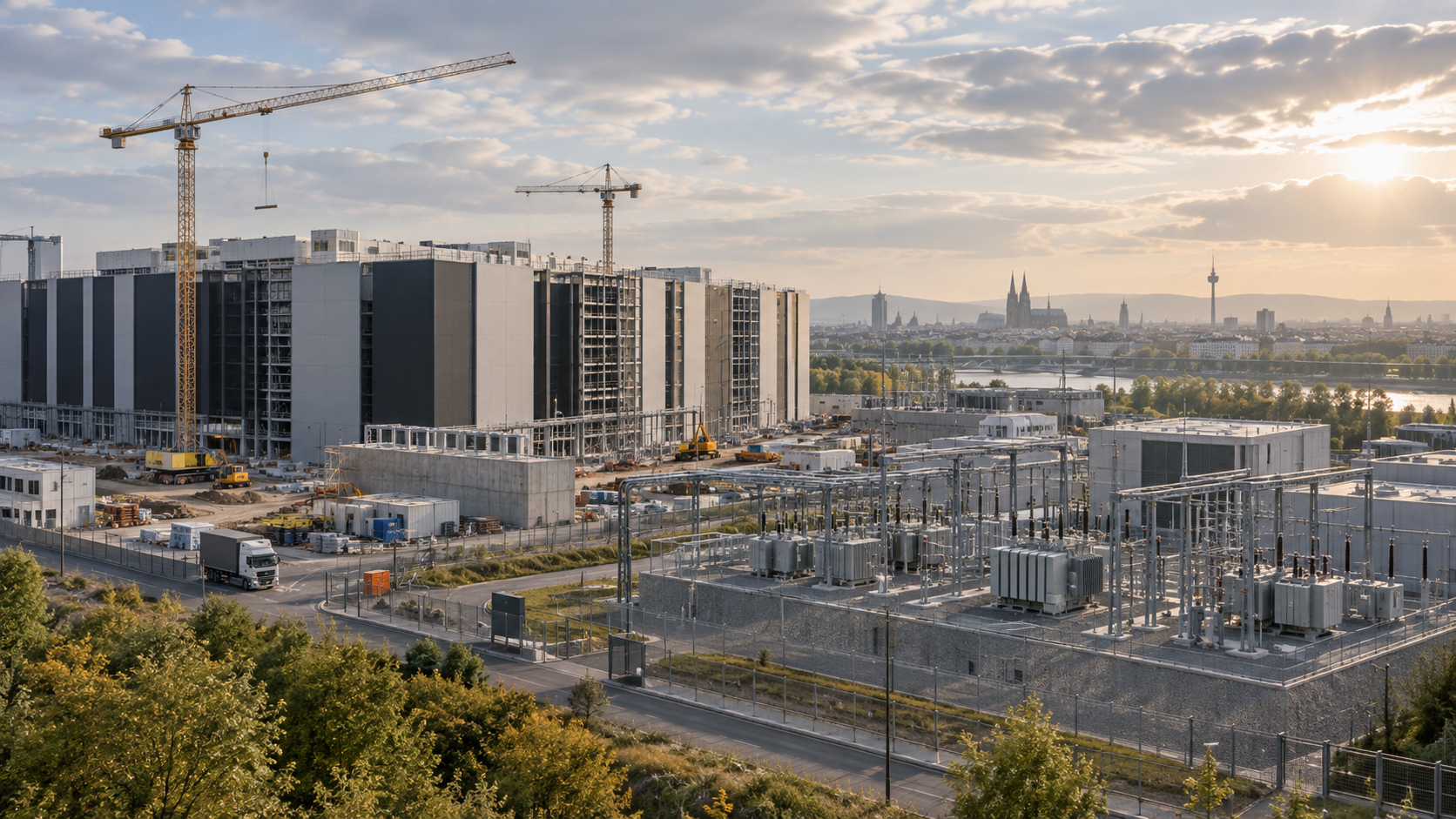
Europe wants to influence the pace of development of the most advanced AI models while accelerating its own investments. In her State of the Union address on 16 September, Ursula von der Leyen announced a discussion with major labs on controlling this race. Two days earlier, Christine Lagarde had put the cost of Europe's data centre deficit over a decade at up to 600 billion euros.
These announcements address two distinct problems: the safety of the most powerful capabilities and European companies' access to infrastructure. They do not yet form a funded programme. Above all, the 600 billion cited by the ECB president corresponds to a high estimate of construction costs, including chips, and not to a public envelope being sought or promised.
Brussels proposes a discussion on the most advanced models
The official record of initiatives plans to bring together the main labs to examine how Europe could support their efforts to control the pace of progress. It also announces cooperation with like-minded partners on evaluation, verification and early warning.
Ursula von der Leyen referred to concerns expressed by industry leaders about models that could contribute to their own improvement. The Next Web reports her support for a slowdown on these models and links the wording to the call published on 12 September by Dario Amodei, CEO of Anthropic. The record gives no date for a meeting or list of invited companies.
The announcement does not define a European moratorium or a compute cap. Its scope will depend on the commitments discussed with the labs, the means of verifying their capabilities and the role of the authorities. Nor does it allow the conclusion that a slowdown would be without consequence for European projects: these use the models, tools and infrastructure of foreign partners.
Berlin emphasises industrial development
The German government has expressed a clearer reservation. In a dts dispatch of 14 September, a spokesperson for the Digital Ministry considers that slowing research and development is not a viable path for Europe. The ministry invokes digital sovereignty, while saying it takes developers' warnings seriously and highlighting its national AI safety institute.
Germany is also coordinating the first Important Project of Common European Interest dedicated to AI. Designed with eighteen other member states, it covers computing, AI technologies and industrial applications. Eleven states announce the start of pre-notification of their aid in September. The amounts and authorised beneficiaries are not published in this release.
The German and European positions cannot therefore be reduced to an opposition between industry and safety. They give different priority to the risk of dependence and to the risks of models. The industrial programme, for its part, must still turn its technical partnerships into authorised funding.
600 billion: a high estimate, with a precise scope
The speech by Christine Lagarde in Vienna details the calculation. A Commission impact study estimates the gap between European demand for data centres and installed capacity by 2036 at 19 gigawatts. The ECB applies to this deficit a cost of about 38 billion dollars per gigawatt, including servers, drawn from an Epoch AI estimate. The result approaches 720 billion dollars, or some 600 billion euros at the exchange rate used.
The methodological caveat is substantial: the deficit covers all types of data centres, while the unit cost used corresponds to AI sites very dense in graphics processors. The figure therefore represents an upper bound, sensitive to assumptions on demand, cost and exchange rates. It does not measure the price of fully catching up with American labs.
Christine Lagarde's financial diagnosis concerns the mobilisation of European capital. Infrastructure requires long-term financing, while labs and strategic technologies need equity able to absorb several years of losses. Her proposal combines local computing capacity, open models usable on this infrastructure and sustainable access to the most powerful foreign systems.
A 15% target that remains that of a coalition
The strategy published on 14 September by a group including Monika Schnitzer, Philippe Aghion and Margrethe Vestager proposes raising Europe's share of global AI data centre capacity to 15% by 2030, from about 5% today according to its authors. This target does not have the status of a commitment adopted by the Union.
The group prioritises securing access to foreign frontier models, a European alliance for supply chains and the development of technologies to verify the safety and use of systems. It also proposes strengthening the technical expertise of institutions. Increasing a relative share in an expanding market would require a capacity increase greater than a simple tripling, if global growth continues.
These recommendations are not to be confused with InvestAI, announced in February 2025 to mobilise 200 billion euros of investment, including a 20 billion fund for gigafactories. Nor are they to be confused with the goal of at least tripling European data centre capacity. A global share target, an investment mobilisation and an estimated construction cost respond to different scopes and horizons; these figures do not add up.
Companies await the content of the November initiatives
The State of the Union address announces for November initiatives in health, transport, agri-food, advanced industry as well as defence and space. The official document does not yet present them as open calls for projects and does not detail their budgets.
Their content will have to specify how companies access the computing, data and models needed for their uses. The IPCEI aid approvals and the outcome of the discussion with the labs will provide two further elements: what will be funded in Europe and the conditions of access to capabilities developed elsewhere. It is these decisions that will make it possible to assess the industrial translation of the September announcements.

Our articles will then appear first in Google Top Stories.