

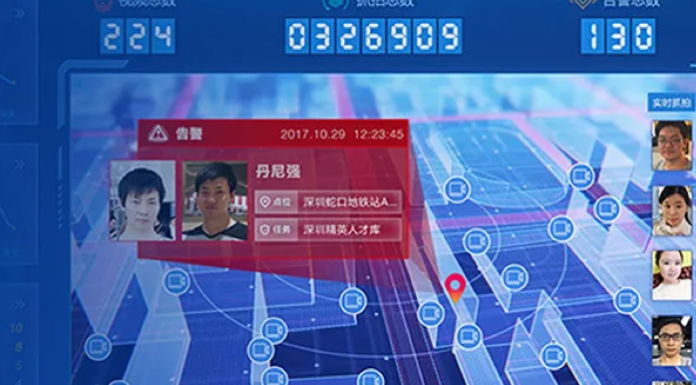
"In Xinjiang and across China, millions of people are suffering outrageous human rights abuses: from mass surveillance and disciplinary police to mass torture, including solitary confinement in cells and forced sterilizations, to intimidation of journalists and activists who have dared to expose the truth. The Chinese government's exploitation of forced labor spans the oceans to our shores and around the world."
Late last week, the U.S. Treasury announced that it had again placed SenseTime on its blacklist due to its facial recognition technology targeting the Uighur minority. As a reminder, in 2019, the blue-chip Chinese company had already been sanctioned for having its proximity to the crackdown on Uyghurs. The company, a specialist in video surveillance and artificial intelligence, has just announced the postponement of its listing on the Hong Kong Stock Exchange for $767 million (679 million euros).
Sino-American relations have been complex for several years. In December, tensions are now focused on SenseTime, which had to postpone its IPO. The company and its technology have been singled out because of their use by the Chinese government on the Uighur population. The massive internment of Uyghurs (a Turkish-speaking Chinese Muslim minority) has been denounced for several years by NGOs indicating that nearly one million of them are incarcerated in camps in Xinjiang.
[caption id="attachment_34347" align="aligncenter" width="640"]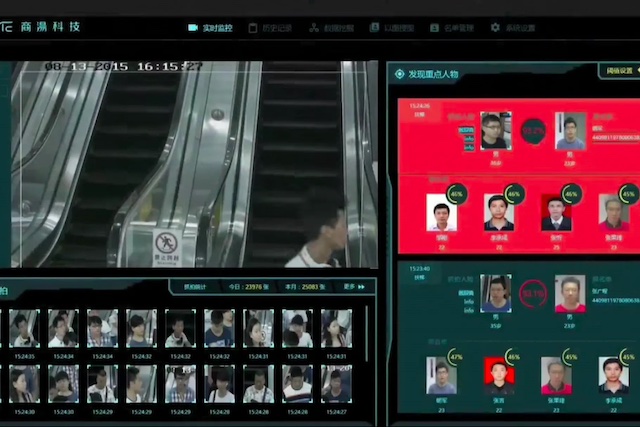 SenseTime[/caption]
In 2019, when the Commerce Department announced the blacklisting of SenseTime, Commerce Secretary Wilbur Ross had justified the decision by stating:
SenseTime[/caption]
In 2019, when the Commerce Department announced the blacklisting of SenseTime, Commerce Secretary Wilbur Ross had justified the decision by stating:
SenseTime[/caption]
In 2019, when the Commerce Department announced the blacklisting of SenseTime, Commerce Secretary Wilbur Ross had justified the decision by stating:
"The U.S. House of Representatives on Wednesday (Dec. 8) passed legislation restricting imports of products made in Xinjiang to condemn the'forced labor' of the Muslim Uyghur minority in the northwestern Chinese region, amid escalating tensions between Washington and Beijing. The Democratic Speaker of the House of Representatives, Nancy Pelosi, stressed:"The U.S. government and the Commerce Department cannot and will not tolerate the brutal suppression of ethnic minorities across China."
Last Friday, the U.S. Treasury blacklisted SenseTime for its facial recognition technology targeting the Uighur minority. The Chinese company, according to the Treasury, "promoted its ability to identify Uyghurs wearing beards, sunglasses and masks" to serve police surveillance in Xinjiang, a practice we discussed in a recent article.
As a result, SenseTime has decided to postpone its listing on the Hong Kong Stock Exchange, "in order to protect the interests of potential investors". However, the Chinese company says it remains "determined" to list soon and has pledged to repay in full those who have already invested. The company said it was "caught in the middle of geopolitical tensions"
and denied the decision:"We strongly object to this listing and the accusations against us. These accusations are unfounded and reflect a fundamental misperception of our business."