


Pre-training a generative model on control points
Instead of leveraging large-scale image or text datasets, the University of California researchers propose learning from checkpoint datasets recorded over many training runs. Neural network checkpoints contain a wealth of information: various parameter configurations and rich metrics such as test losses, misclassification errors and reinforcement learning feedback that drives checkpoint quality. The researchers pre-trained a generative model on millions of checkpoints and used it in testing to generate parameters for a neural network that solves a downstream task. They called their model G.pt (G and .pt refer to generative models and control point extensions, respectively). G.pt is trained as a diffusion model based on the neural network parameter transformation. It takes as input a starting parameter vector (potentially randomly initialized), the starting loss/error/return, and the user's desire: loss/error/return. Once trained, it samples a parameter update from the model that matches the user's requested metric. Their pre-training dataset contains 23 million neural network checkpoints over 100,000 training runs. It contains data from MLP and CNN neural networks trained for vision tasks (MNIST, CIFAR-10) and continuous control tasks (Cartpole). [caption id="attachment_40224" align="alignnone" width="1600"]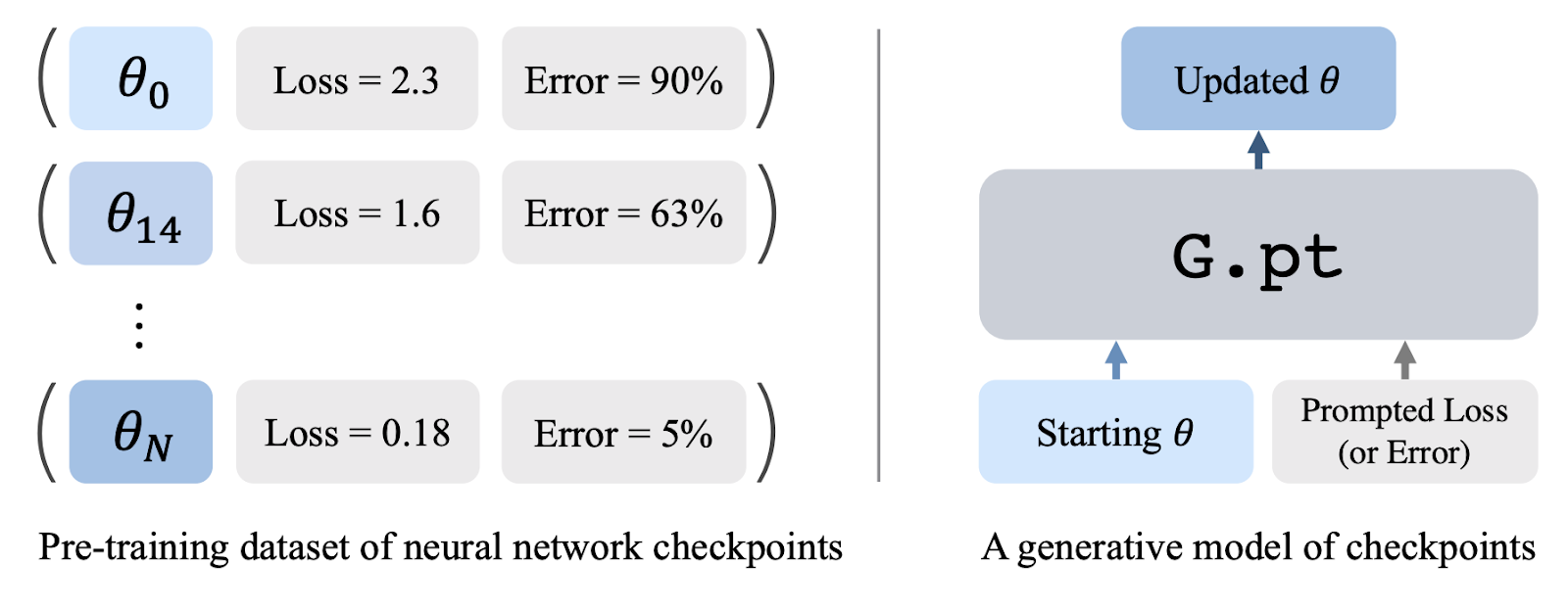 Generative pre-training from control points. Left: Building a dataset of neural network control points. Each control point includes neural network parameters and relevant metadata (losses and test errors for supervised learning tasks, returns for RL tasks). Right: G.pt, a generative model of control points. G.pt takes a parameter vector and a loss/error/return prompt as input and predicts the distribution over the updated parameters that yield the prompt.[/caption]
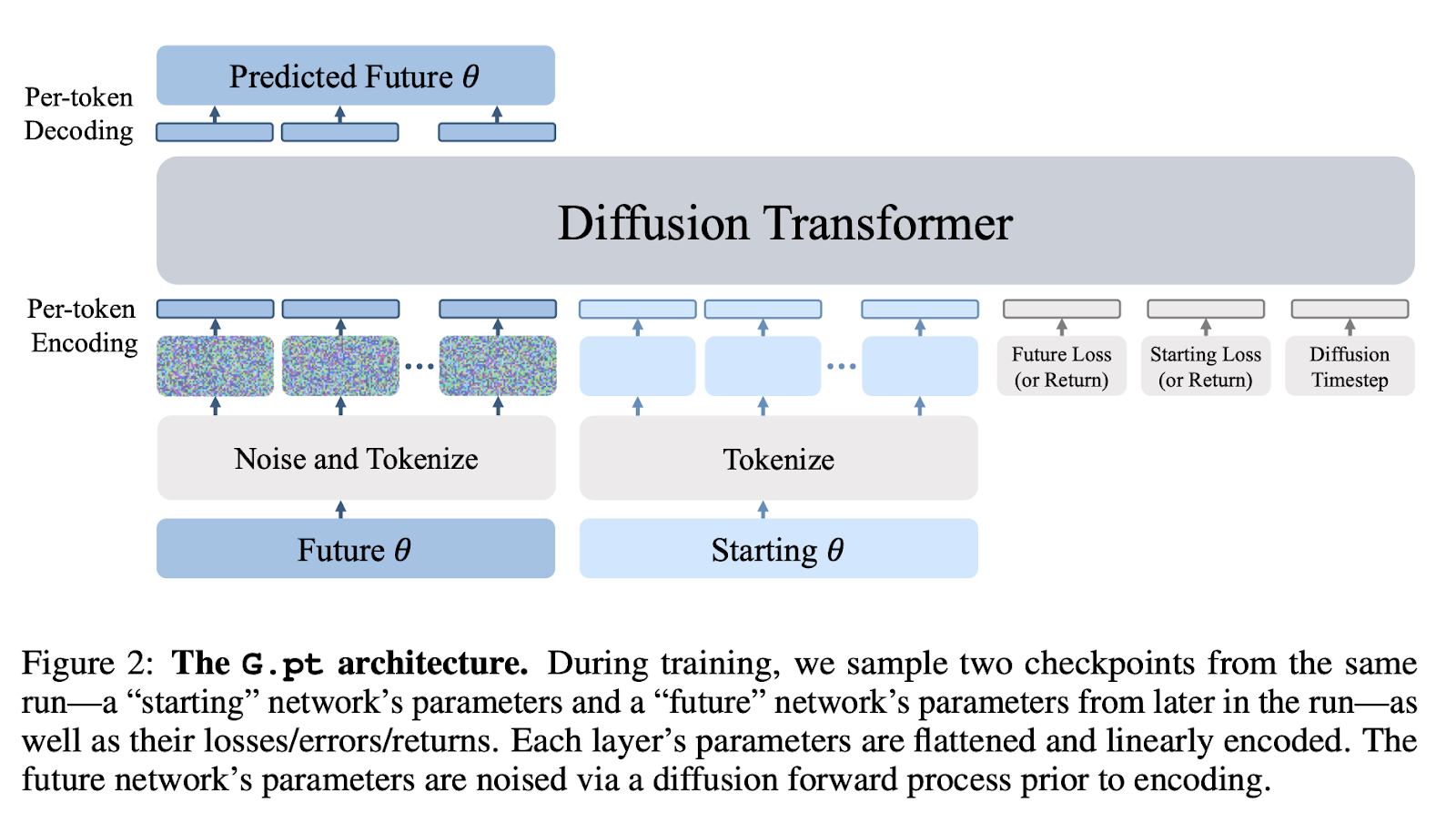
The backbone of their diffusion model is a transformer that operates on sequences of neural network parameters.
The G.pt model was trained for a given dataset, metric, and architecture (e.g., a loss-conditional CNN CIFAR-10 model, an error-conditional MLP MNIST model...). The backbone of their diffusion model is a transformer that operates on sequences of neural network parameters and uses little domain-specific inductive bias beyond tokenization.
 The researchers thus demonstrated that their approach has a number of favorable properties. First, it can quickly train neural networks from unseen initializations with a single parameter update. Second, it can generate parameters that allow for a wide range of losses, errors, and induced feedback. Third, it is capable of generalizing to off-distribution weight initialization algorithms. Fourth, as a generative model, it is capable of sampling various solutions.
Another advantage of this method over traditional optimizers is that it can directly optimize non-differentiable metrics, such as classification errors or RL returns. Indeed, G.pt is trained as a diffusion model in parameter space, and the researchers were not required to backpropagate through these metrics in order to train their model.
Article source:
LEARNING TO LEARN WITH GENERATIVE MODELS OF NEURAL NETWORK CHECKPOINTS
arXiv:2209.12892v1, 26 September 2022
Authors: William Peebles, Ilija Radosavovic, Tim Brooks, Alexei A. Efros, Jitendra Malik.
University of California, Berkeley
Translated from Des chercheurs de l'UC Berkeley optimisent les réseaux neuronaux grâce à des modèles génératifs de points de contrôle

Our articles will then appear first in Google Top Stories.