

A promising market
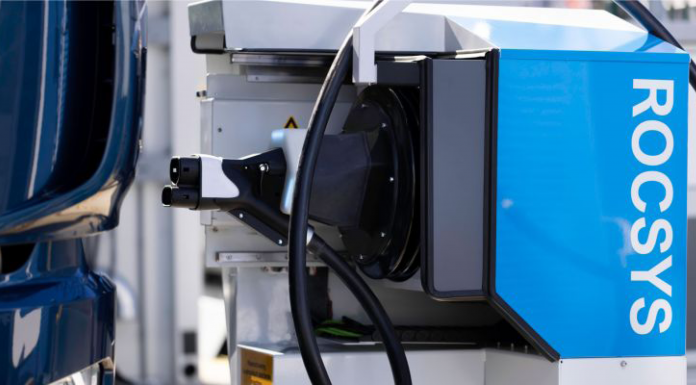
Electric vehicles are growing in number, with estimates that there will be at least 145 million of them worldwide by 2030. There are stations or fast-charging stations provided free of charge by many supermarkets, but also on freeway service areas and in towns and villages. The queues at these stations will unfortunately increase. The company points out:"Waiting times at public charging stations will increase, leading to more queues. Frustration can lead to connector misuse and a dissatisfied customer."To avoid customer mishandling through clumsiness or annoyance, Rocsys has developed a system that takes care to make the connection smoothly, sparing both the connectors and the cables, especially those that are liquid-cooled. Rocsys adds:
"This will reduce the need for maintenance and increase the life of the equipment."Rocsys' autonomous charging solutions for standard electric vehicle charging connections combine AI-based computer vision, patented soft robotics and remote services.
Seamless plug-in navigation with computer vision
Computer vision is the main guiding principle of these robots. This technology seamlessly directs the plug to the socket. This highly advanced vision solution provides 3D information from a single camera. This gives the robot the information it needs to robustly direct the plug to the socket. The deep learning based computer vision algorithms are trained to work in harsh weather conditions such as rain, snow, fog and sunlight. With integrated LED lighting, the system operates day and night. In addition, this soft robotics technology ensures that the plug finds its way safely into the socket in a sometimes difficult and demanding customer environment. It must manage and absorb unexpected vehicle movements and allow the customer to unload cargo, passengers or drivers simultaneously with the electric recharge.Remote services and SaaS for a truly seamless experience
Rocsys robots are intelligent, connected, allow remote operation, diagnosis and assistance, and can be installed on existing charging stations. The company offers cloud-based API integrations that allow customers to create a seamless and comprehensive global fleet operation.Many applications
Autonomous charging can be of interest to vehicle manufacturing units (for end-of-line charging), automotive R&D centers, autonomous fleet test pilot programs, vehicle test tracks, automated valet parking, logistics sites, airports, truck and bus depots, and more.For electric tractors
The latest contract signed this month calls for Rocsys to provide autonomous charging solutions for electric logistics tractors to SSA Marine in Oakland, California, the world's largest independent, privately owned marine terminal operator. The order is part of a project to fund zero-emission equipment and vessels at three California ports and is supported by $50 million in funding from the California Air Resources Board (CARB). Translated from Rocsys, start-up néerlandaise, propose une solution pour le branchement autonome des câbles aux bornes de recharge
Our articles will then appear first in Google Top Stories.