

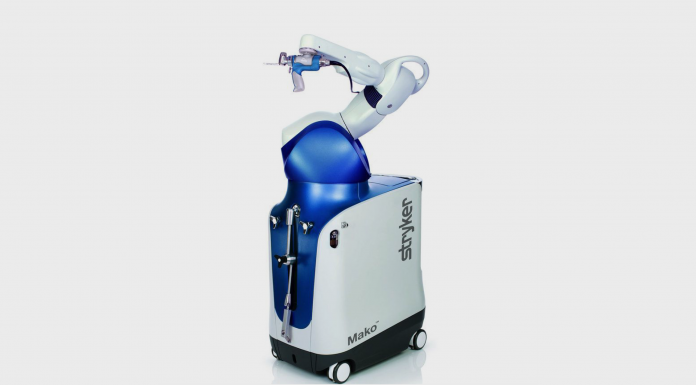
The Hospices Civils de Lyon are experts in knee and hip surgery, fitting more than 3,000 prostheses each year. To optimize and secure these operations, the orthopedic surgery departments of the Hospices Civils de Lyon have benefited from an additional technological innovation with the arrival of the Mako® surgical robot from the Stryker company. This assisted surgery system has made it possible to install dozens of knee and hip prostheses every month. The acquisition of the Mako® robot is in line with the University Hospital's policy of making robotic surgery an area of excellence, and thus enabling the HCL orthopedic surgery departments to maintain their leadership.
Since the 1990s, robotic systems have continued to progress. They improve the precision of the surgical gesture and its reproducibility. Interventions are less invasive, less traumatic, and preserve the musculature around the joints. Last February, the HCL received a latest generation system. The use of this robotic system will be shared between the orthopedic surgery departments of the Croix-Rousse and Lyon Sud hospitals.
Mako®, a high-performance assistant thanks to the latest generation of robotics
Whatever the brand, material and model of joint prosthesis chosen by a surgeon, the quality of the fitting is essential. A 3D study based on CT scans, surgical navigation, and customized cutting guides improve the procedure, but the Mako® robot corrects any inaccuracies. Mako® is a semi-active robot initially developed for the implantation of partial knee prostheses. It is now also used for total hip and knee replacements. It offers new personalized approaches and provides a considerable technical advance for the benefit of patients and healthcare professionals. In practice, from the patient's scan, the software associated with the robotic system creates a 3D anatomical model and its modeling after virtual implantation of the prosthetic components under permanent control of a navigation system and the surgeon. The surgeon can therefore visualize the patient's anatomy, choose the best surgical strategy and then direct the robot during the operation. Each operation is thus personalized. Dr. Anthony Viste, deputy head of the orthopedic surgery department at Lyon Sud Hospital, explains:"The robot will follow, to the letter, the surgeon's indications and thus make the gesture more precise in order to improve the survival of prosthetic implants and patient satisfaction."