

The study: comparative analysis of AlphaFold-enabled molecular docking predictions for antibiotic discovery
The team of researchers, led by James Collins, Termeer Professor of Medical Engineering and Science at MIT's Institute for Medical Engineering and Science (IMES) and Department of Biological Engineering, investigated whether AlphaFold could accurately predict interactions between bacterial proteins and antibacterial compounds, which could lead to the development of new antibiotics. Efficiently identifying drug mechanisms of action remains a challenge. Computational docking approaches have been widely used to predict drug binding targets. Yet such approaches are dependent on existing protein structures, and accurate structural predictions are only recently available from AlphaFold2. For this study, the researchers combined AlphaFold2 with molecular docking simulations to predict protein-ligand interactions between 296 proteins spanning the essential proteome of Escherichia coli, and 218 active and 100 inactive antibacterial compounds, respectively, indicating widespread promiscuity of compounds and proteins. They then compared model performance by measuring the enzymatic activity of 12 essential proteins treated with each antibacterial compound. This allowed them to confirm widespread promiscuity, but also found that the average area under the receiver operating characteristic curve (atROC) was 0.48, indicating poor model performance. The researchers showed that rescoring docking poses using machine learning -based approaches improves model performance, resulting in auROCs with an average of 0.63. They also found that correction function sets improve prediction accuracy and the ratio of true positive to false positive rates. [caption id="attachment_39364" align="aligncenter" width="2128"]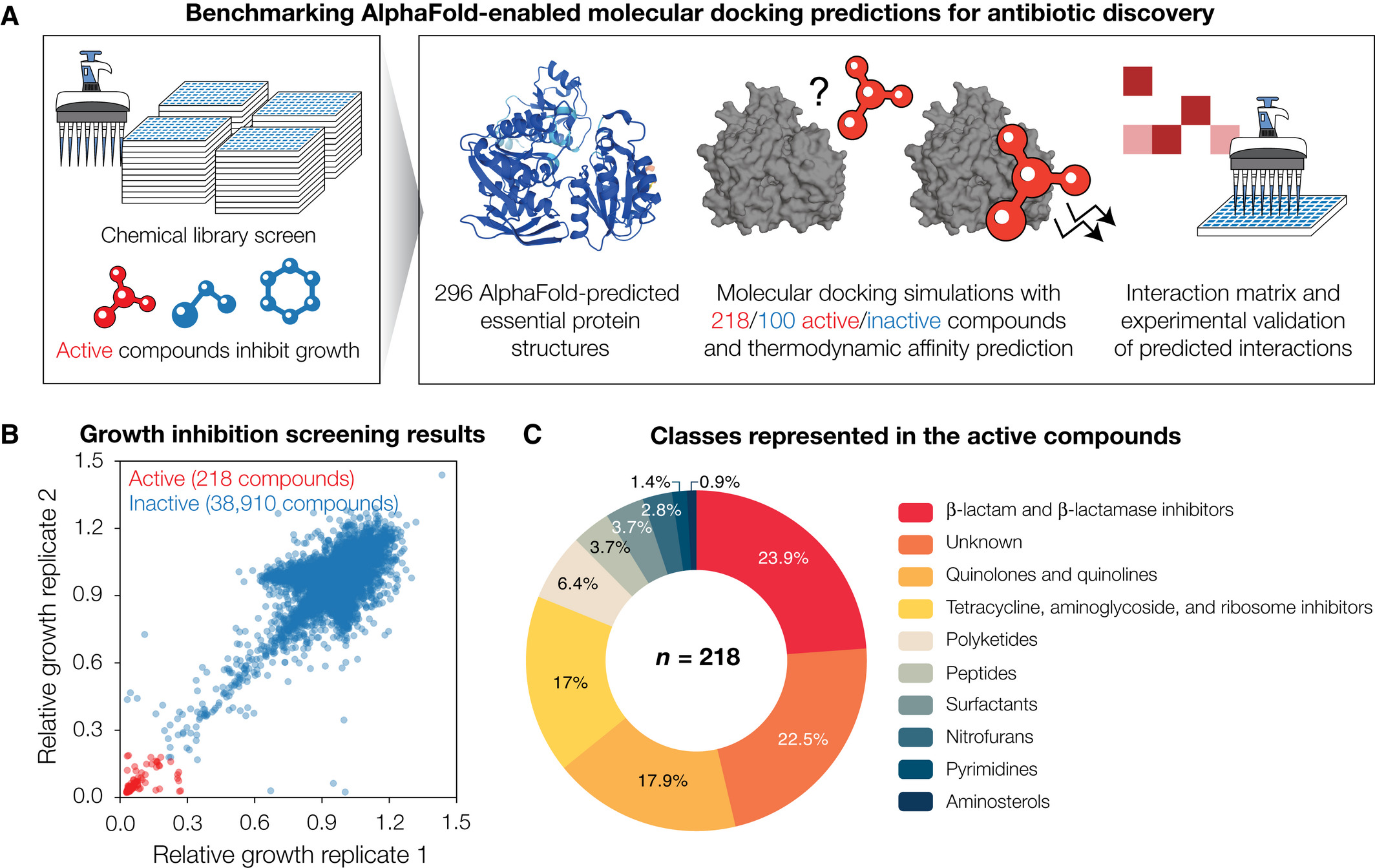 A) To define the chemical space of interest, the researchers performed high-throughput growth inhibition screens against wild-type E. coli. Compounds that inhibited growth were considered active, and each active compound was computationally docked to each of the 296 essential E. coli protein structures predicted by AlphaFold2. B) Growth inhibition measurements for 39,128 compounds, from which 218 compounds (including known antibiotics) were identified as active against E. coli BW25113. Data were obtained from two biological replicates. Compounds with an average relative growth of less than 0.2 were classified as active (red dots) and all other compounds were classified as inactive (blue dots). C) Distribution of compound classes represented in the 218 active compounds[/caption].
Results of the study
The study demonstrated the potential of AI to streamline the selection process of future antibiotics. However, the results suggest that while AlphaFold2 can provide rich structural information, methods to more accurately model protein-ligand interactions are needed to better exploit AlphaFold2 for drug discovery. Article references: "Benchmarking AlphaFold-enabled molecular docking predictions for antibiotic discovery" doi.org/10.15252/msb.202211081 Published in the journal " Molecular Systems Biology" on September 6, 2022. Authors: Wong F, Krishnan A, Zheng EJ, Stark H, Manson AL, Earl AM, Jaakkola T, Collins JJ. 18: e11081. Affiliations: Felix Wong1,2,3,AartiKrishnan1,2,3, Erica J Zheng3,4, Hannes Stärk5, Abigail L Manson3, Ashlee M Earl3, Tommi Jaakkola5 andJames J. Collins 1,2,3,6- 1Institutefor Medical Engineering & Science, Massachusetts Institute of Technology, Cambridge, MA, USA
- 2Departmentof Biological Engineering, Massachusetts Institute of Technology, Cambridge, MA, USA
- 3InfectiousDisease and Microbiome Program, Broad Institute of MIT and Harvard, Cambridge, MA, USA
- 4Programin Chemical Biology, Harvard University, Cambridge, MA, USA
- 5ComputerScience and Artificial Intelligence Laboratory, Massachusetts Institute of Technology, Cambridge, MA, USA
- 6WyssInstitute for Biologically Inspired Engineering, Harvard University, Boston, MA, USA.

Our articles will then appear first in Google Top Stories.