

"The digital transition is accelerating. Most Member States are making progress in building resilient digital societies and economies. Since the beginning of the pandemic, we have made considerable efforts to support Member States in the transition, whether through the recovery and resilience plans, the EU budget or, most recently, the structured dialogue on digital education and skills. Because we need to make the most of the investments and reforms needed to achieve the goals of the 2030 digital decade. So the changes need to happen now."
All EU countries have gaps in key areas
Even Finland, Denmark, the Netherlands, and Sweden, which are at the top of the rankings in terms of digitization, are experiencing gaps in key areas: the adoption rate of advanced digital technologies, such as AI and megadata, is less than 30 percent, far from the 75 percent target set for the digital decade by 2030.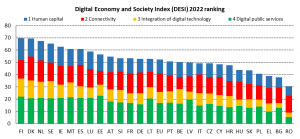 Nevertheless, the adoption of digitization has continued and countries that were lagging behind in this area are gradually reducing it like Italy, Greece or Poland.
A lack of skills
On March 9, 2021, the European Commission presented tracks for the digital transformation of Europe and the objectives to 2030 of the EU digital decade in 4 sectors:- IT skills;
- Secure and sustainable digital infrastructure;
- Digital transformation of businesses;
- Digitalization of public services.
Very low use of AI
Businesses stepped up their use of digital solutions during the pandemic, with 34% turning to the cloud, but only 14% using megadata and 8% using AI, compared to a target of 75% by 2030. Yet these key technologies offer enormous potential for innovation and efficiency gains, especially for SMEs. Only 55% of them have achieved at least a basic level of digitization, whereas the target is at least 90%.Connectivity is improving but needs to be improved
By 2021, gigabit connectivity in Europe has increased further: 50% of households have adopted fiber, and overall coverage by very high capacity fixed network has reached 70%, with the target being full coverage. Meanwhile, 5G coverage also increased last year to 66% of populated areas in the EU. Yet, the report points out that"the assignment of 5G spectrum radio frequencies, which is an important prerequisite for the commercial launch of 5G, is still not complete: only 56% of the harmonized 5G spectrum has been assigned in the vast majority of member states (Estonia and Poland are the exceptions)." Furthermore, according to the DESI 2022, some of the very high coverage rates rely on sharing 4G frequencies or low-band 5G spectrum, thus not allowing full deployment of advanced applications.Digitization of public services in the EU
Online delivery of essential public services is commonplace in most EU member states. In the context of the European Commission's plan to establish a European Digital Identity Portfolio, 25 Member States have implemented at least one eID scheme, but only 18 of them have one or more eID schemes that comply with the EU eIDAS regulation, which is a key element for the security of cross-border digital transactions. Translated from La Commission Européenne publie les données de l'Indice relatif à l'économie et à la société numériques 2022
Our articles will then appear first in Google Top Stories.