

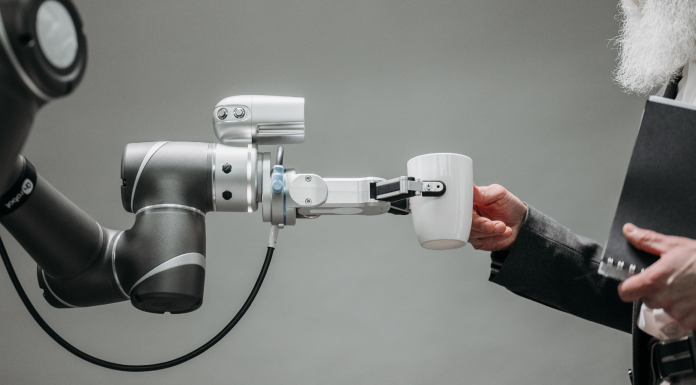
Description of the ELSA project by Mehdi Khamassi, project coordinator
What is the project about?
"Study the learning of social affordances in robots. Affordances are opportunities for actions perceived by an agent to interact with its environment. They are of interest to roboticists to describe the potential interactions of the robot with objects beyond simple physical properties." The ELSA project team has extended the notion to social affordances, which have so far been little studied in robotics. It hypothesized the following:- Robots can learn social affordances in the same way that they learn affordances in non-social situations;
- Robots, by learning to autonomously recognize the social affordances of their human partners, will be able to respond more effectively and appropriately to humans. This would facilitate coordination and cooperation between humans and robots.
What is the objective of the project?
"The central goal of the project is to study the conditions that allow a robot to effectively learn social affordances in ways that facilitate communication and cooperation with humans. " The team studied the problems related to social affordances in robotics and defined 4 lines of work:- Theory and practice of social affordances;
- Social affordances in decision making;
- Social affordances for action execution;
- Architecture, scenario, integration.
What are the possible applications?
According to Mehdi Khamassi, the main application of this work is human-robot interaction, and more specifically, human-robot cooperation. A better understanding of how robots can learn to recognize and express social affordances will allow the design of more cooperative robots, assisting humans in various tasks. In addition, this project will further the fundamental knowledge of how humans learn, perceive and express social affordances. Mehdi Khamassi concludes:" In general, the project addresses a critical lack of basic knowledge about how social affordances are learned and used in the context of human-robot interaction. The major strength of the project is that it addresses a relatively unexplored subfield (social affordances in robotics) that builds on well-studied areas (non-social affordances in robotics, but also in psychology). In the continuity of the previous works of the consortium, the project is highly interdisciplinary and involves complementary expertise. One of the work packages will set up experiments to study the learning of social affordances in humans. One of the main originalities is that these experiments have been designed from questions and hypotheses formulated thanks to the reflection in robotics. We will therefore bring a fresh look at these questions in order to also make a contribution to experimental psychology."Translated from Projet ELSA : apprentissage effectif des affordances sociales pour l’interaction humain-robot

Our articles will then appear first in Google Top Stories.