

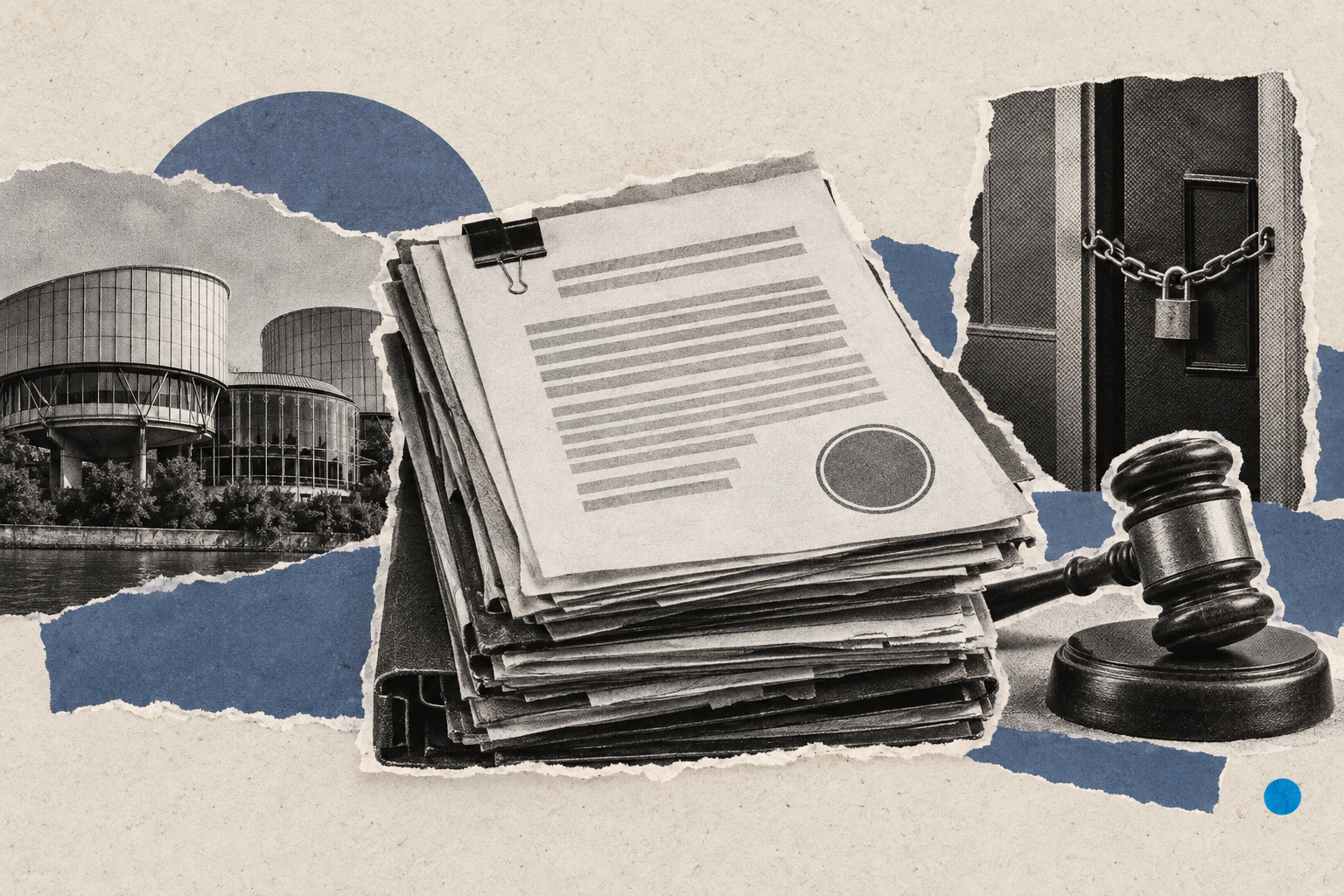
“Inaccuracies” and “faulty citations”. A Romanian lawyer used these two expressions before the European Court of Human Rights to describe the errors in the written observations she had drafted with AI tools. These observations cited cases that do not exist and attributed invented paragraphs to real judgments and decisions. Some of the case law invoked, which was real, had no connection with her arguments or contradicted them. She admitted that she had not sufficiently verified all her references. The Chamber that examined her observations saw this admission as an understatement.
On 13 November 2026, on a reasoned proposal from that Chamber, the President of the Court, Mattias Guyomar, banned her from representing or assisting applicants before the Court for two years. The decision, made public on 18 November, is based on Rule 44D of the Rules of Court, which allows a representative to be excluded “in exceptional circumstances”. It applies to pending applications as well as to those that may be lodged with the Court in the future. The lawyer shared representation of the application in question with another representative, who is not affected by the exclusion.
The Rules also provide, in Rule 36 § 4 c), a narrower measure, which allows the President of a Chamber to exclude a representative from a single set of proceedings, after giving him or her an opportunity to comment, the applicant then having to seek another representative. Rule 44D, chosen by the Chamber, closes access to the entire Court and may apply for an indefinite period. It requires a reasoned decision by the President, taken after the person concerned, the government and the bar associations concerned have had an opportunity to submit observations. The Romanian Government and the National Romanian Bar Association did so. Invited, the Iași Bar Association did not comment.
The measure is not without precedent. On 21 October, before the Committee of Ministers of the Council of Europe, Mattias Guyomar had indicated that he had banned a Ukrainian representative for five years, because of his conduct and on a proposal from a Section, from representing parties before the Court.
The Chamber finds the errors repeated and easy to detect
The Chamber speaks of repeated substantive errors, not isolated citation errors. For some references, no verification had been carried out. Many errors would have been spotted by a quick check on HUDOC, the Court's case law database. The lawyer had to check herself, before filing her observations, every reference and every argument produced by the AI against authoritative sources.
This obligation, the Chamber derives from Romanian Law No. 51/1995 on the legal profession and from the Court's case law, which require lawyers to exercise reasonable professionalism and, before the Court, great professional care. Verifying the observations took the Court considerable time, and the exclusion procedure required lengthy exchanges with the other stakeholders. The Chamber considers this work incompatible with the functions entrusted to the Court by the Convention. It concludes that the lawyer harmed the administration of justice and that the threshold of exceptional circumstances has been met.
The duty to verify stems from the ordinary obligations of a lawyer
The Rules of Court say nothing about artificial intelligence. The guidelines on the use of generative AI by courts, adopted in December 2025 by the CEPEJ, the Council of Europe's commission for the efficiency of justice, recommend including in procedural rules an obligation to disclose the use of generative AI, accompanied by sanctions in case of silence. The Chamber did without such a text. By basing the obligation to verify on the ordinary duties of a lawyer, it gives its decision a broad scope: the reasoning applies to any representative admitted before the Court, regardless of the tool that produced the false reference.
Rule 44D § 3 allows the lawyer to request, with reasons, to be reinstated. The President then decides after consulting, if appropriate, the Chamber, the government and the bar associations concerned.
Several national courts have punished AI-invented references with a financial penalty, or are seeking the power to do so. In New York, two lawyers and their firm were fined 5,000 dollars in 2023 in the case Mata v. Avianca, and the South Korean judicial administration is calling for a legal basis for a fine, as ActuIA reported in its article on Korean justice. In the Czech Republic, the Constitutional Court fined a lawyer whose appeal cited twelve decisions of that court and of the ECHR, a significant proportion of which did not exist, according to the law firm IRPA, which reported the case on 8 July 2026.
The Court is also preparing its own use of AI. Before the Committee of Ministers, Mattias Guyomar indicated that the Registry proposed to use it gradually, in particular for translation and cybersecurity, and that a group of judges was to propose an ethical charter “adopted and published before any development in this area”.

Our articles will then appear first in Google Top Stories.