

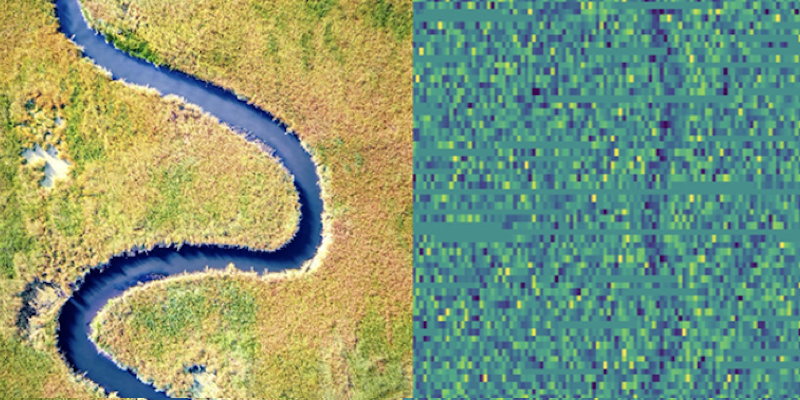
"This is why we thought of using artificial intelligence applied to image recognition. It is indeed possible to teach a machine, using a large number of examples, to take into account all the parameters and predict the effect of interactions between planets in a pictorial representation of the induced effect."
An efficient artificial neural network to identify objects.
UNIGE and his associates will use an already known algorithm: the one that helps drive autonomous cars by spotting the road, sidewalks, signs and pedestrians perceived by the camera. This algorithm, used for the detection of exoplanets, will have to indicate whether there is an eclipse for each measurement of the star's luminosity by cross-checking all the configurations seen during its training. In the context of exoplanet detection, the goal is to determine, for each measurement of the star's luminosity, if the eclipse of a planet is observed. The neural network makes its decision by cross-referencing all available observations of that star with the range of configurations seen during its training. Adrien Leleu explains:"From the first implementations of the method, we discovered two exoplanets ( Kepler-1705b and Kepler-1705c which had been totally missed by previous techniques. The planetary systems thus discovered are a gold mine for our gold mine for our knowledge of exoplanets, and more particularly of Earth-like planets that are generally difficult to characterize."Thanks to this method, it is possible to estimate the radius of the planets and their mass, and therefore their density and composition. Yann Alibert, professor at the University of Bern and scientific officer of NCCR PlanetS is very enthusiastic and states:
"The use of AI, in particular the technique of deep learning, is becoming more and more widespread in astrophysics, whether to process observational data as in this paper, or to analyse results from huge numerical simulations producing terabytes of data. What we have developed in this study is a new example of the fantastic contribution that these techniques can make in our field, and probably in all fields of research.
A useful technology on Earth
This method has proved its effectiveness in astronomy, and could also prove valuable for observing the Earth and its environment. Grégory Châtel, R&D manager at Disaitek confirms:"While developing this technology, we quickly realized its potential for application to other problems for which a small amount of data is available.Disaitek is now using this AI to address environmental issues, including the detection of illegal dumping and dumping sites, using very high resolution satellite images. In the future, it could be a way to solve critical environmental problems. Reference: Alleviating the transit timing variation bias in transit surveys. I. RIVERS: Method and detection of a pair of resonant super-Earths around Kepler-1705 A&A. Leleu, G. Chatel, S. Udry, Y. Alibert, J.-B. Delisle, R. Mardling - A&A, Forthcoming article - DOI: https://doi.org/10.1051/0004-6361/202141471 Translated from A la découverte des exoplanètes grâce à l'Intelligence Artificielle

Our articles will then appear first in Google Top Stories.