


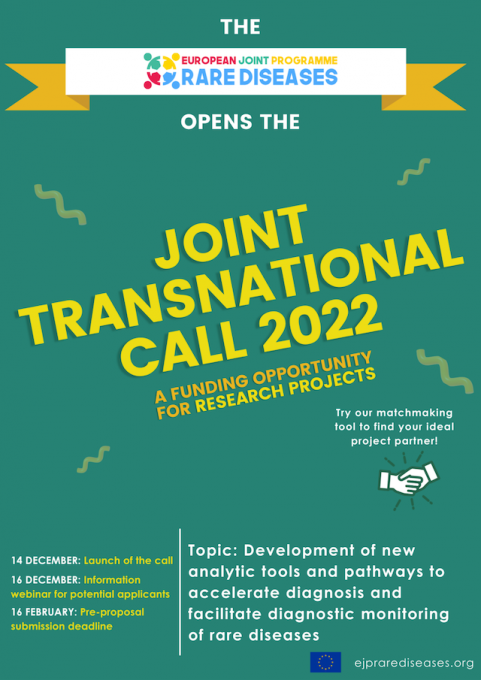
Objective of the call
The overall objective of the call is to enable scientists from different countries to establish an effective collaboration on a joint interdisciplinary research project based on complementarities and sharing of expertise, with a clear future benefit for patients. A two-stage submission procedure will be set up for joint applications: pre-proposals and full proposals. The call is scheduled to open in December, with a deadline for submission of pre-proposals in February. Projects must address a group of rare diseases or a single rare disease, as defined at European level, i.e. a disease affecting no more than five out of every 10,000 people in the European Community, the EC Associated States and Canada. Only transnational projects will be funded. Each consortium submitting a proposal to this JTC 2022 call must have at least four principal investigators from four different countries and no more than two eligible partners from any one country (other national limits may apply). The maximum duration of a project is three years and where a project is patient-centred, patient participation may add value. Transnational research projects must cover at least one of the following areas of equivalent relevance to this call:-
- Phenotype-based diagnosis: integration between different ontologies, integration of shared pathways, digital phenotyping, development of artificial intelligence approaches/applications to extract health-related data for diagnosis.
- Prognostic marker/biomarker searches for early diagnosis and disease monitoring.
- Methodologies for solving cases that are currently difficult to analyse due to different underlying mechanisms (e.g. mosaicism, genomic (non-coding) alterations, gene regulation, complex inheritance), including new genomics/functional genomics technologies, multi-omics, mathematics, biostatistical approaches, bioinformatics and artificial intelligence.
- Functional strategies to globally stratify variants of unknown significance (VUS) for clinical use; establishment of systems(in vitro) to distinguish between VUS and pathogenic variants (e.g. confirmation of splicing disruption for deep intronic variants, loss of protein function and gain of toxic protein function).
- Development of pathway models to enable diagnosis, particularly for newly discovered diseases that may share underlying molecular mechanisms with previously known diseases.
A call limited to specific fields
The following approaches and topics are excluded from the scope of the call:- Interventional clinical trials to prove the effectiveness of drugs, treatments, surgical procedures, medical technology procedures. This also includes studies comparing the effectiveness of, for example, two surgical techniques or therapies. Phase IV clinical pharmacovigilance studies are also not eligible for funding.
- Studies on tests exclusive to the safety of medical devices.
- Development of new therapies as covered in the RD 2020 PAA.
- Projects focused solely on rare neurodegenerative diseases that are the focus of the Joint Programming Initiative on Neurodegenerative Diseases (JPND). These are: Alzheimer's disease and other dementias; Parkinson's disease (PD) and PD-related disorders; prion diseases; motor neuron diseases; Huntington's disease; spinal muscular atrophy and dominant forms of spinocerebellar ataxia. Interested researchers should refer to the relevant JPND calls. However, childhood dementia/neurodegenerative diseases are not excluded.
- Rare infectious diseases, rare cancers and rare adverse events in the treatment of common diseases. Rare diseases with a predisposition to cancer are not excluded.

Our articles will then appear first in Google Top Stories.