

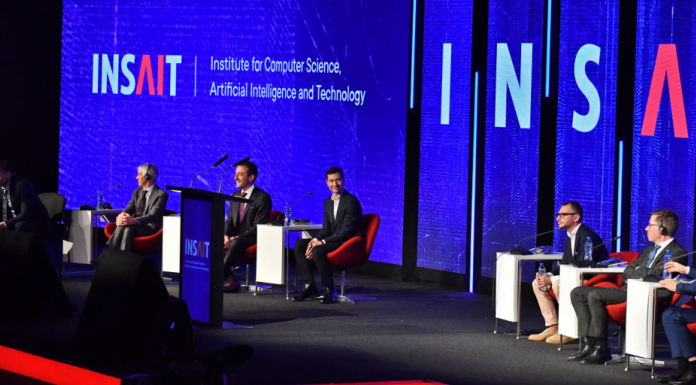
THE INSAIT
The institute will open in September 2022, and will be supervised and advised by world-renowned scientists from ETH Zurich, EPFL, IST Austria, MIT, UC Berkeley, Yale, Princeton and Technion-Institute of Technology. Its president is Martin Vechev, a native of Sofia, a graduate of the Sofia High School of Mathematics (SMG), and currently a professor of computer science at ETH Zurich where he heads the Secure, Reliable, and Inteligent Systems Lab. It is thanks to him that this institute was created. The institute is modeled after the computer science departments of top universities such as MIT, UC Berkeley, ETH, Technion, Max-Planck, and its areas of focus include machine learning, natural language processing, computer vision, programming languages, quantum computing, computer architecture, information security, and other technology areas.Preventing brain drain
Innovation in Eastern Europe is strongly impacted by the brain drain, with an estimated 30,000 Bulgarians leaving their country each year to study and pursue their careers in a Western country. INSAIT, the first research center in Eastern Europe, will offer world-class research environments and internationally competitive salaries, attracting foreign researchers and encouraging the best young talent to stay in the country, which will have a significant economic and social impact throughout the region. Martin Vechev states:"Eastern Europe is full of brilliant scientific minds - but too often people's aspirations are limited due to lack of facilities, funding and support. This has led to a 'brain drain' from Eastern Europe, a systemic problem that discourages innovation. INSAIT is perfectly positioned to reverse this trend and compete on a global scale."He adds:
"AWS, Google, and DeepMind understand the importance of bridging the science and technology gaps between East and West to promote inclusive economic growth and recovery, democratize science, and attract top talent focused on solving some of the toughest AI challenges. We also have their support to promote diversity and inclusion in science, encouraging applications from women and other underrepresented groups in technology and science."Amazon Web Services will provide $3.75 million in funding over the next five years to support INSAIT's research on automated reasoning, the algorithmic search for proof in mathematical logic. AWS is integrating automated reasoning into a range of customer solutions, including Provable Security, a solution that provides high security in the cloud. Byron Cook, vice president and scientist at Amazon Web Services (AWS), said:
"Today, at any given time, scientists, engineers and software developers are creating the next innovation that will change our lives forever. At AWS, we are committed to helping individuals gain the new skills they need for the jobs of tomorrow. With the launch of INSAIT in Sofia, we look forward to equipping the future workforce with advanced automated reasoning and research skills, and helping foster a culture of innovation and entrepreneurship that will benefit society as a whole."For its part, Google is investing $3 million over three years to provide INSAIT with cloud computing resources and access to Tensor Processing Unit Research Cloud, a specialized infrastructure for running high-performance machine learning models. Jeff Dean, Senior Fellow at Google, said:
"Google is very proud to support the work of INSAIT. Eastern Europe has an incredible talent pool of computer scientists and engineers, and we want to help INSAIT become a world-class facility, attracting the best researchers from the region and beyond. There is still much to be done in the field of AI and computer science, and initiatives like these are critical to ensuring that the technology benefits everyone. I look forward to seeing the groundbreaking work to come from NISD!"In addition, DeepMind is investing $285,000 to fund two PhD scholarships for women.
Bulgarian government and business involvement
INSAIT has also received an initial endowment of nearly $100M over 10 years from the Bulgarian government and a $7M investment from local companies including £6.5M from SiteGround. The unanimous ratification by Parliament of this international agreement between ETH Zurich, EPFL and Sofia University and the fact that scientific research in computer science is receiving public funding and support in Eastern Europe, sets a precedent for the country and the region. Translated from Bulgarie : Lancement d'INSAIT, Institut d'informatique et de technologie, soutenu financièrement par Google, AWS et Deepmind
Our articles will then appear first in Google Top Stories.