

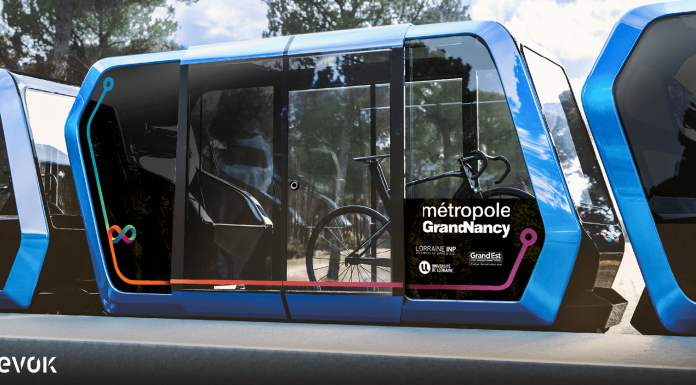
While many countries, including France, are working on the train of the future running in a low-pressure tube, the hyperloop, according to the concept imagined by Elon Musk in 2013, Urbanloop, as its name indicates, targets the urban and suburban market. The aim is to compete effectively with the use of cars in the city by offering an ecological, inexpensive and ergonomic alternative for medium-sized cities whose population densities do not make a metro or tramway profitable: individual capsules. The project has won the 2021 call for innovation in mobility for the 2024 Olympic and Paralympic Games and will be tested on that occasion.
If Urbanloop is a start-up created in 2019, currently engaged in the realization of two transport projects, one with the metropolis Grand Nancy, the second with Saint Quentin en Yvelines, it is thanks to a project of the University of Lorraine in 2017, that it came into being. The students had to propose the optimal solution in terms of mobility, the choice fell on an individual, electric, environmentally friendly public transport without waiting at the platform, driven by AI.
The University of Lorraine has 50,000 students and trains architects, urban planners, engineers and technicians in the fields of AI, transport, civil engineering, energy and geology, skills that have made this project possible.
The Urbanloop project
The original project aimed, among other things, to fight against urban congestion while preserving the particularly rich architectural heritage of the city of Nancy. Urbanloop's capsules, whose flow is managed by AI, allowing users not to wait for an empty capsule to arrive, circulating at 60 km/h on a network adapted to the city's constraints, are an alternative to the car and meet these objectives. Directed by Jean-Philippe Mangeot, it brought together the University of Lorraine, the Henri VOGT high school, 3 research laboratories (CRAN, LORIA, GREEN) and several local industrialists: Chardot TP, which built the first 200-meter demonstration loop, the Constructions Métalliques de VOID... A hundred students worked on sub-projects to complete it. Among them:- 7 students from the Henri VOGT high school worked on the lane change and accessibility systems for the capsule;
- ENSEM for the control-command platform, the realization of the individual capsule, the PMR capsule, the dimensioning and the implementation of the propulsion system for the capsules;
- Telecom Nancy for the algorithmic part, for the simulation of the urban transport network by capsules and for the signaling station;
- Mines Nancy for the flow management, 3D modeling and risk management;
- Geologie Nancy for the georadar measurement campaign;
- Artem Insight-Alliance Artem for the design of the capsule and the stations of the first line at the Technopôle Brabois.