

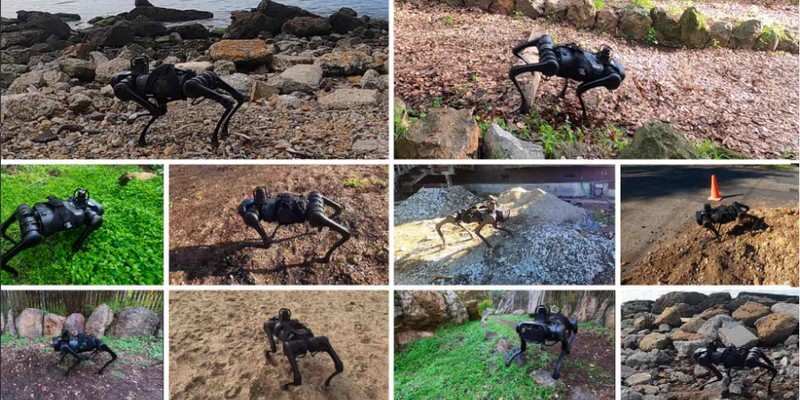
Through Rapid Motor Adaptation (RMA ),Facebookis making progress in adapting robots to their environment in order to develop their motor skills.
 Until now, legged robots were either completely hand-coded for the environments they encountered or experts made them learn to navigate their environments through a combination of hand-coding and machine learning techniques.
Adapting robots to an environment just like a human can do in everyday life
Humans can walk with relative ease over rocks, through mud, up and down hills, or jump on trampolines or balance on a rather soft surface. This is made possible by our powerful yet flexible muscles that adapt to the conditions of the environment in which we find ourselves. A research team consisting of experts from FAIR, the University of Berkley and Carnegie Mellon University used this observation in humans to design an AI model called Rapid Motor Adaptation (RMA) that allows legged robots to adapt in real time to a variety of environments.
Until now, legged robots were either completely hand-coded for the environments they encountered or experts made them learn to navigate their environments through a combination of hand-coding and machine learning techniques.
An adaptation model designed using reinforcement learning and supervised learning
RMA uses a combination of two AI-related methods in order to function:- First module - Reinforcement learning: the tool exploits reinforcement learning by using information it selects from the different environments it may encounter (friction, weight and shape of the payload, etc.). The robot adapts to the ground's adherence as well as to its inclination.
- Second module - Adaptation module: it was not possible, according to the researchers, to rely solely on reinforcement learning, as it is not possible to know in advance what real elements the robot might encounter on its way. Supervised learning was used by the research team as an "adaptation module" so that the robot could adapt to these hazards. This module was trained using supervised learning.