

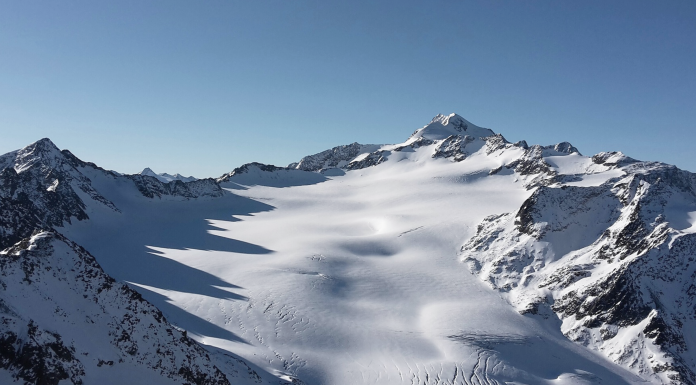
Glaciers in the French Alps
The study team chose to study the glaciers of the French Alps, which are experiencing one of the most consistent retreats in the world. This rapid retreat of glaciers is already having an environmental impact on natural hazards (dam failure, boulder avalanche...), mountain ecosystems and biodiversity. Glaciers in the region have been observed for several decades, while the evaluation simulation covers the period from 2003 to 2015.A different approach
In general, numerical models allow scientists to simulate, in a simplified way, the evolution of glaciers for entire regions or for the entire planet, whether for past or future periods. Most of these models use a calibrated linear relationship between positive degree-days and ice or snow melt, whereas glacier evolution is non-linear, i.e. it does not evolve constantly over time. Deep artificial neural networks are nonlinear models that offer an alternative approach to these classical methods but they are very little used in glaciology for regression problems. For the study, the modeling was based on a deep learning mass balance and glacier-specific parameterizations. According to the researchers:"deep learning captures a nonlinear response of glaciers to air temperature and precipitation, improving the representation of extreme mass balance rates compared to linear statistical and temperature index models."
Study results
Projections show a large loss of glacial mass in the French Alps estimated at between 75% and 88% compared to 2015 by the end of the century. The study predicts that glaciers in the Arctic and Patagonia, which are the world's largest ice reserves after Greenland and Antarctica, would be most impacted by global warming. Sources: Bolibar, J., Rabatel, A., Gouttevin, I. et al. Non-linear sensitivity of glacier mass balance to future climate change revealed by deep learning. Nat Commun 13, 409 (2022). https://doi.org/10.1038/s41467-022-28033-0. Translated from Etudier l'évolution des glaciers face au changement climatique grâce à l'Intelligence Artificielle
Our articles will then appear first in Google Top Stories.