

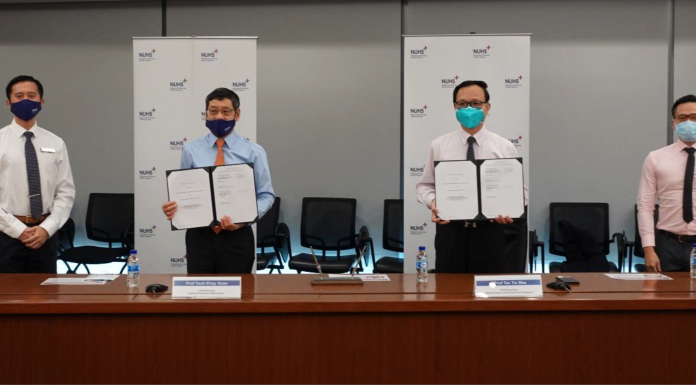
"The health system sees a large number of patients per day and generates large amounts of data that can be used to train AI models that improve the quality of care." "Normally, this can take days to process, but the new supercomputer could help reduce our training times to hours allowing our physicians and paramedics to optimize patient trajectories and improve the quality of patient care"
On the other hand, NUHS has also partnered with telecom giant Singtel to deploy a 5G indoor network with multi-access edge computing capabilities in the operating rooms and wards of the National University Hospital, which is a first for a public hospital. NUHS noted:
"The high-speed connectivity of 5G will address current latency and bandwidth limitations, and open up opportunities for better healthcare experiences, such as smoother teleconsultations, augmented surgery using mixed reality devices, and robotic AI capabilities using cloud and edge computing"
In addition, Ngiam said NUHS would use Prescience to train conversational chatbots that can converse with people in a more natural way and that:
"These conversational chatbots have many use cases - for example, advising patients on chronic disease care"
The new supercomputer should also help identify genetic variations when studying genes and in developing AI imaging tools, such as identifying spinal cord problems. It can also be used to train other systems. One is AI that helps a machine identify objects in common places, such as along a hospital corridor.
Translated from Les Hôpitaux de Singapour vont se doter d'un superordinateur pour booster l'IA

Our articles will then appear first in Google Top Stories.