

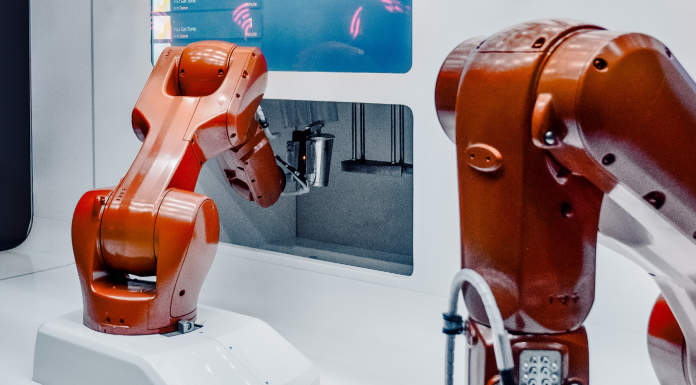
"There are already different studies that predict the number of jobs that will soon be robotized, but they all focus on software robots, such as voice and image recognition, robot financial advisors, dialoguers, etc. Moreover, these predictions vary widely depending on job requirements and software capabilities. Our study considers not only artificial intelligence software, but also actual intelligent robots that perform physical work. We developed a method that systematically compares human and robotic capabilities required in hundreds of jobs."
Assessing the risk of automation
To assess the automation risk index (ARI) of each job, the researchers referred to the Occupation Information Network (O*NET), a U.S. market database of 967 job profiles. For each job, O*NET provides a profile composed of a list of required abilities, skills and knowledge. The researchers selected 87 human capabilities. In addition to human capabilities, they also studied a set of robotic capabilities that robots and AI are already capable of performing or will be able to perform in the future. For this, they used a list of capabilities defined in the SPARC Multi-Annual Report (MAR), a document published by SPARC, a public-private partnership between the European Commission and EU-robotics, which represents the European robotics industry. After selectively matching human capabilities from the O*net list to robotic capabilities in the MAR document, the team was able to calculate the likelihood for each existing job to be performed by a robot. The study classified the 967 jobs: physicists are the least likely to be replaced by a robot, while people working in slaughterhouses are at the highest risk. In general, jobs in the food industry, building and maintenance, construction and mining seem to be the most exposed to robotization. The authors then created a method to find the conversion for any job that has a significantly lower risk of automation, while being close to the original job in terms of skills and knowledge required. To do this, they used data on the U.S. workforce and simulated thousands of job conversions based on the algorithm's suggestions. Professor Rafael Lalive, who co-led the study at the University of Lausanne, concludes:"Today, the major challenge for society is to prepare to deal with automation. Our work provides detailed career advice to workers facing high risks of automation, allowing them to choose safer jobs while reusing many of the skills they acquired in their previous jobs. With this advice, governments can help society become more resilient to automation."Translated from Robotique : quels sont les métiers amenés à disparaître avec la robotisation ?

Our articles will then appear first in Google Top Stories.