

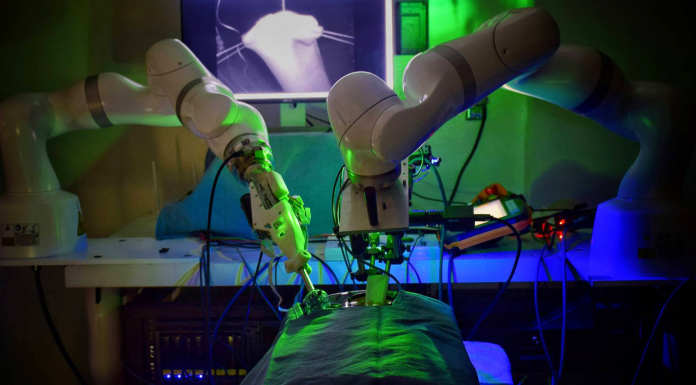
The new STAR
Autonomous anastomosis requires complex imaging, tissue tracking, and surgical planning techniques, as well as precise execution, often in unstructured and deformable environments; it is even more challenging when performed laparoscopically. Researchers at Children's National Hospital in Washington, D.C., including Axel Krieger, and Jin Kang, professor of electrical and computer engineering at Johns Hopkins, have enhanced the robot with new features for increased autonomy and surgical precision, using specialized suturing tools and advanced imaging systems that provide more accurate visualizations of the surgical field. A three-dimensional structural light-based endoscope and a machine learning-based tracking algorithm developed by Kang and his students guide STAR. Jin Kang states:"We believe that an advanced three-dimensional computer vision system is essential to make intelligent surgical robots smarter and safer."In addition, an autonomous control system adapts the surgical plan in real time, just as a surgeon would. For his part, Axel Krieger adds:
"What makes STAR special is that it is the first robotic system to plan, adapt and execute a surgical plan in soft tissue with minimal human intervention."
Study findings
Axel Krieger, lead author of the study, states:"Our results show that we can automate one of the most complex and delicate tasks in surgery: reconnecting the two ends of a bowel. The STAR performed the procedure in four animals and produced significantly better results than humans performing the same procedure."Also according to him:
"robotic anastomosis will ensure that surgical tasks that require high precision and repeatability can be performed with greater accuracy and precision for each patient, regardless of surgeon skill. In our view, this will result in a democratization of surgical care with more predictable outcomes."Article source: autonomous robotic laparoscopic surgery for intestinal anastomosis Translated from Robotique : le robot chirurgien STAR effectue des coelioscopies de façon autonome

Our articles will then appear first in Google Top Stories.