

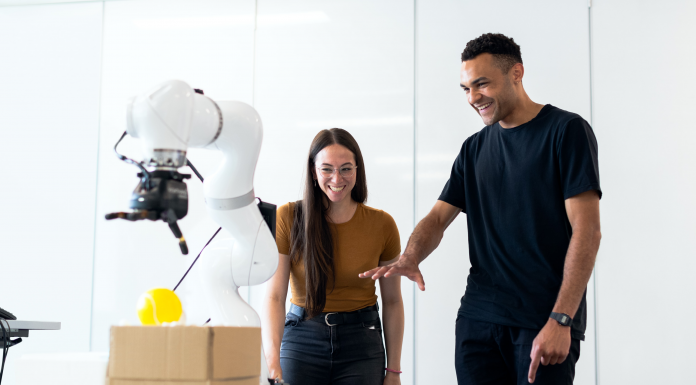
"How people safely interact with robots is at the forefront of current research related to automation and manufacturing."She continued:
"It is extremely important that manufacturing robots perform their tasks in the safest and most efficient way possible.In order to make these automated machines as intelligent as possible, we are developing systems that perceive their environment and perform tasks in the same way as their human partners."For successful RHC in an industrial setting, robots must be intelligent and mobile, but also have awareness of their environment and the human collaborator. For Debasita Mukherjee, "adaptingto uncertainty in an industrial environment is the biggest obstacle." In the research, she introduces some rules for human-robot interactions in an industrial setting and tests their effectiveness. She explains:
"Increasing levels of automation are standardized and accepted by the automotive industry, but other industrial environments, while relatively static, do not have the same standards. In the future, not only will industrial automated systems continue to use sensors to enable perception and communication similar to human capabilities, but they will also adapt and communicate in real time with their environment. "To develop these systems, the study authors used artificial intelligence and machine learning to guide the machines. They present the different machine learning (ML) methodologies and their industrial applications for adaptive collaborative robots. The goal of the research is "to achieve the seamless team dynamics and communication fluidity of a fully human team while using robots." Sources: https: //doi.org/10.1016/j.rcim.2021.102231 Translated from Des chercheurs de l'UBCO, en Colombie-Britannique, ont mis au point un système pour améliorer les interactions homme-robot

Our articles will then appear first in Google Top Stories.