

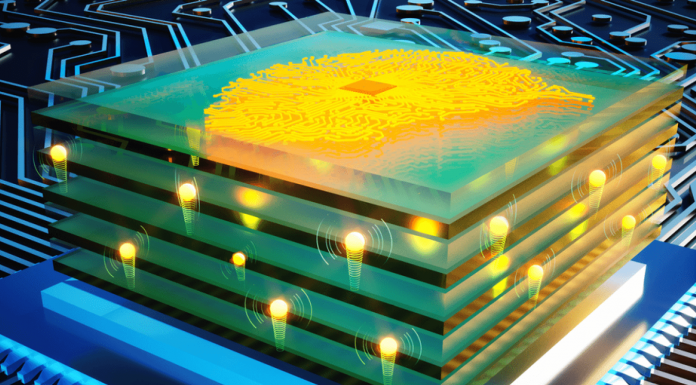
Analog deep learning
Programmable resistors are essential elements for deep learning, just like transistors for digital processors. There are two main reasons why analog deep learning is faster and more energy-efficient than digital deep learning: the computation is performed in memory, so the huge data loads are not transferred from memory to a processor, and the second reason is that analog processors also perform operations in parallel. Although the size of the matrix increases, an analog processor does not need more time to perform new operations, since all calculations are performed simultaneously. To develop a programmable proton resistor, a key component of the MIT team's analog processor, that is ultra-fast and highly energy-efficient, the researchers turned to different materials for the electrolyte and chose inorganic phosphosilicate glass (PSG). The PSG is composed of silicon dioxide, a powdery desiccant material found in boxes when buying shoes, for example. To make it, a small amount of phosphorus is added to the silicon to give it special proton conduction characteristics. Murat Onen thought " that an optimized PSG could have high proton conductivity at room temperature without the need for water, making it an ideal solid electrolyte for this application." The study proved him right.Surprising speed
The inorganic phosphosilicate glass has a multitude of nano-sized pores that allowed protons to move very quickly. It also has the ability to withstand very strong pulsed electric fields. This is critical, explains Murat Onen, because applying more voltage to the device allows the protons to move at blinding speeds. He states:"The speed was certainly surprising. Normally, we wouldn't apply such extreme fields to all devices, so as not to turn them into ashes. But instead, the protons ended up shuttling at immense speeds through the pile of devices, in particular a million times faster than we had before. And this motion doesn't damage anything, thanks to the small size and low mass of the protons. It's almost like teleporting. "Ju Li adds:
"The nanosecond time scale means that we are close to the ballistic or even quantum tunneling regime for the proton under such an extreme field. "Because protons do not damage the material, the resistor will be able to " operate for millions of cycles without breaking down." The PSG created a programmable proton resistor that is a million times faster than the researchers' previous device and can operate efficiently at room temperature, which is important for integration into computer hardware. Murat Onen adds:
"Thanks to the insulating properties of PSG, almost no electric current flows through the material when the protons move. This makes the device extremely energy efficient. "Jesús A. del Alamo, concludes:
"With this key idea, and the very powerful nanofabrication techniques we have at MIT.nano, we were able to put these parts together and demonstrate that these devices are inherently very fast and operate with reasonable voltages. This work has really brought these devices to a point where they now look very promising for future applications. "Article sources: "Nanosecond protonic programmable resistors for analog deep learning " DOI: 10.1126/science.abp8064 Authors: Murat Onen; Nicolas Emond; Baoming Wang; Difei Zhang; Frances M. Ross; Ju Li; Bilge Yildiz; Jesús A. del Alamo Translated from Une équipe de chercheurs du MIT créée des résistances protoniques programmables en nanosecondes pour l'apprentissage profond analogique

Our articles will then appear first in Google Top Stories.