

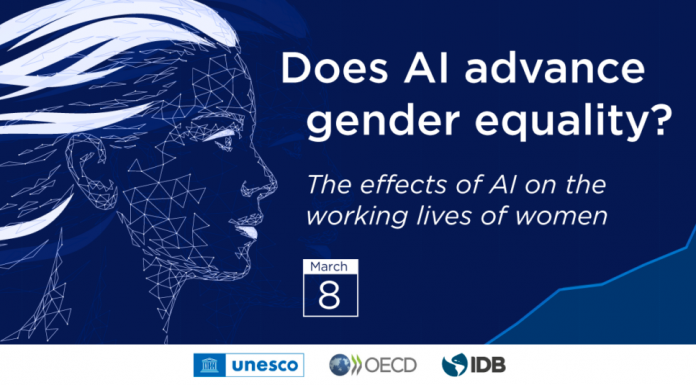
Online event: 'The effects of AI on women's working lives'.
The discussion will be based on the new joint UNESCO, OECD and IDB report "The Effects of AI on Women's Working Lives" and will focus on the three main themes highlighted in the report:- Changing skill needs in the labor market;
- The effects of AI on women entering the labor market;
Keynote Address:
- Tawfik Jelassi , Assistant Director-General, UNESCO,
- Ulrik Vestergaard Knudsen , Deputy Secretary-General, OECD.
Confirmed panelists :
- Dorothy Gordon, Chair of the Information for All Programme and Board Member of the Institute for Information Technologies in Education, UNESCO
- Tamara Dancheva, Senior Director of International Relations, GSMA
- Dirk Meyer, Head of the Directorate General for Global Health, Private Sector, Trade and Rural Development, German Federal Ministry for Economic Cooperation and Development
- Marta Ochoa, Youth Director and Senior Equal Opportunities Coordinator, UNI Global Union
- Livia Gouvea Gomes, Labour Market Expert, IDB.
AI to close the gender gap.
While AI algorithms have replicated our society's biases, it's not too late to bend their impacts for women's work lives with reliable, socially representative data.AI for job search.
One of the key challenges for employment services is to facilitate the matching of skills required in job vacancies with those available to job seekers. A BID report "Artificial Intelligence for Job Search "from 2020 focuses on how artificial intelligence (AI) can be used as a tool to improve the matching approach, as far as considering existing relationships in various occupations, which can include more information in the analysis of job applicants' profiles. Today, artificial intelligence powers many job search engines, online job postings, and referrals and is used to automate parts of the hiring process for large companies. However it is the employers who choose the data on which Artificial Intelligence selects future employees, so the algorithms incorporate their biases. For example, in 2015, Amazon had acknowledged that its algorithmic recruiting evaluated candidates for developer positions in a gender-biased way. On the other hand, AI algorithms based on successful past hires in the tech sector, where women are underrepresented, may perpetuate bias in the future, thus exacerbating gender inequality in the sector.Women's digital skills.
In 2020, UNESCO published a study explaining the role that gender-responsive education can play in ending gender-based conceptions of technology and ensuring gender equality in digital education. The paper highlighted the paradox of ICT: countries with the highest levels of gender equality, such as Europe, also have the lowest rates of women pursuing higher education leading to employment in the technology sector. The study also drew attention to the fact that digital assistants are almost all feminized. While industrial robots have mostly male names, personal assistants whose main function is to serve, listen and serve have female voices and are called Siri or Alexa. The research that will serve as the basis for discussion in this panel shows that women in the workforce today are in fewer leadership positions, are less likely to have science, technology, engineering, and math (STEM) skills, are in more precarious jobs, and, on average, are paid less for the same work than their male counterparts.Conclusions.
Studies have found that teams with mixed AI projects are the most successful. Women's place in the AI world is therefore strategic, and encouraging careers in the science and digital world is essential to increasing women's representation. Governments and civil society have a role to play in ensuring that women thrive in an AI-based future. Developers must ensure transparency and accountability, as well as share research and data. This will allow governments, organizations, academics, and others to monitor and mitigate gender bias in AI systems. To attend the event: https: //oecd.ai/en/women-event-2022 Translated from Evénement en ligne dans le cadre de la Journée Internationale de la femme 2022 : L'IA fait-elle progresser l'égalité des sexes ?
Our articles will then appear first in Google Top Stories.