

- DAEDALUS hosted by the National Infrastructures for Research and Technology in Greece,
- LEVENTE hosted by the Government Agency for Informatics Development in Hungary,
- CASPIr hosted by the National University of Ireland Galway (NUI Galway) in Ireland,
- EHPCPL hosted by the CYFRONET AGH Academic Computing Center (CYFRONET) in Poland.
The JUPITER exascale supercomputer
The supercomputer should be the first in Europe to exceed the threshold of one trillion calculations per second, which Frontier, the American supercomputer, is the only one to have crossed last May. It is expected to help meet current scientific challenges (the fight against pandemics, global warming, sustainable energy production, etc.) and to enable intensive use of AI and the analysis of large volumes of data. The total cost of the system is €500 million: EuroHPC JU will finance half of it, the German Federal Ministry of Education and Research (BMBF) and the Ministry of Culture and Science of the State of North Rhine-Westphalia ( MKW NRW), where the JSC is located, will contribute the remaining €250 million.Modular supercomputing architecture
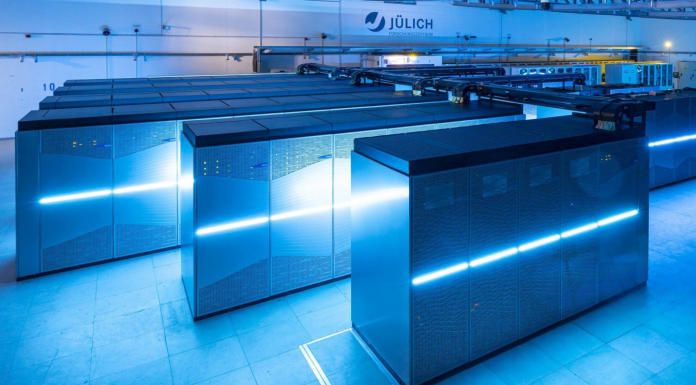
Like the existing JUWELS supercomputer in Jülich, JUPITER will be based on a dynamic, modular supercomputing architecture, which the Forschungszentrum Jülich has developed in collaboration with European and international partners within the framework of the EU's DEEP research projects. In a modular supercomputer, different computer modules are coupled to each other, which allows complex simulation program parts to be distributed over several modules and the different hardware properties to be used optimally in each case. Jupiter will also be able to integrate new technologies such as quantum computing and neuromorphic modules in the future.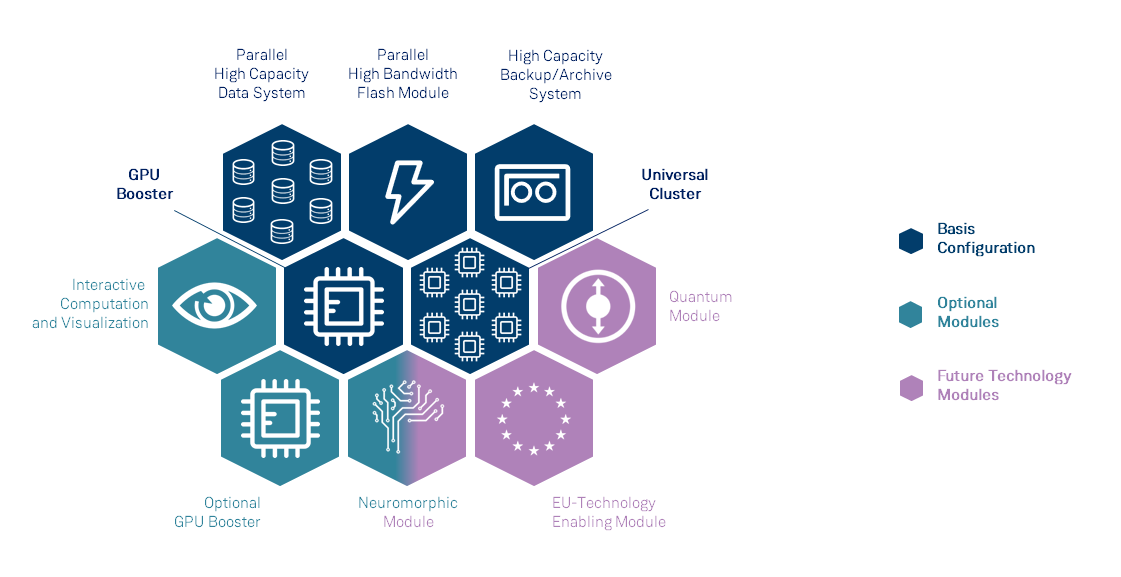 According to the Jülich, " In its basic configuration, JUPITER will have an extremely powerful booster module with highly efficient GPU-based computing gas pedals. Massively parallel applications will be accelerated by this booster in the same way as a turbocharger, for example to calculate high-resolution climate models, develop new materials, simulate complex cellular processes and energy systems, advance basic research or train the next generation of computationally intensive. machine learning algorithms."
A green supercomputer
One of the challenges for supercomputers is their energy efficiency. JUPITER is expected to average 15 megawatts(MW) while Frontier, 1st in the Green 500 and Top500 most powerful supercomputers in the world, is close to 21MW. LUMI, 3rd in the Green 500 and Top500, consumes about 3MW. JUPITER has been designed as a "green " supercomputer and will be powered by green electricity. The cooling system makes intelligent use of the heat generated: like its predecessor JUWELS, JUPITER will be connected to the new low-temperature network of the Forschungszentrum Jülich campus. Moreover, LUMI is also powered by green energy and the reuse of the heat it generates will be used to heat the neighboring houses. Hendrik Wüst, Minister-President of North Rhine-Westphalia, said:"Forschungszentrum Jülich has once again made its mark with its unique modular supercomputer architecture: Europe's first exascale supercomputer is coming to North Rhine-Westphalia. This is a mark of recognition for the scientific community and the overall excellence of our state. As a location, it offers extensive possibilities for a massive increase in system performance, right up to the integration of quantum modules into an exascale computer. The technologies currently being developed will shape future applications in all areas related to the simulation of highly complex systems and will enable us to make even more reliable statements in critically important areas such as climate and brain research, traffic management, and the development of evacuation scenarios for major events. This cutting-edge supercomputing research gives us every opportunity to solve the great challenges of our time. As a federal state government, we are pleased to support this pioneering development."Translated from Allemagne : Le 1er supercalculateur Exascale européen sera installé au centre de recherche Jülich

Our articles will then appear first in Google Top Stories.