

The materials of tomorrow
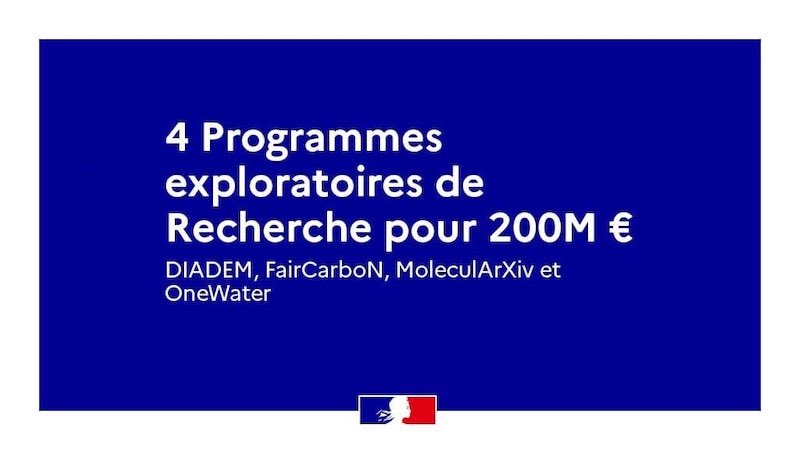
The Diademe project, which stands for "Integrated devices for accelerating the deployment of emerging materials", aims to develop innovative, high-performance, sustainable materials from non-critical and non-toxic raw materials. This will be achieved rapidly thanks to four platforms - for the synthesis, characterization and digital simulation of materials, as well as for the storage, management and exploitation of databases by AI - integrated into dedicated competence centers. This PEPR is co-directed by CEA and CNRS, in partnership with Université Paris-Saclay, Sorbonne University, Institut Polytechnique de Paris, Université Grenoble-Alpes, Université de Lorraine, Université de Bordeaux, Université de Lyon.Better understanding the carbon cycle
The exploratory PEPR FairCarbon project focuses on the carbon cycle in order to identify ecological, agronomic and socio-economic levers and trajectory scenarios for achieving carbon neutrality and restoring natural resources in continental ecosystems. Led by CNRS and Inrae, in partnership with IRD, CIRAD, CEA, the University of Paris-Saclay, Aix-Marseille University and the University of Montpellier, it also intends to support the implementation of these scenarios at local and national levels, while making available to the scientific community digital models validated on open data sets.Storing data on DNA
The third PEPR selected is led by the CNRS, in partnership with Inria, the University of Strasbourg, the University of Paris Sciences et Lettres and the University of Côte d'Azur: MoleculArXiv aims to store massive data on DNA and artificial polymers. It aims to position the French academic (computer science, chemistry, biology, nanotechnology, microfluidics) and industrial research ecosystem as a key player in polymer (DNA and non-DNA) storage on an international scale.Water, a common good
Finally, the OneWater programme, which focuses on water as a "common good", is organised into major scientific and technical challenges, from anticipating changes in water resources to enable adaptation, to the transition to a new governance of resources for a sustainable and resilient society, including water as a sentinel of the health of the environment and human societies. It is co-directed by CNRS, BRGM and Inrae, with the participation of Ifremer, IRD, Météo France, University of Bordeaux, University Claude Bernard Lyon 1, University of Montpellier, University of Grenoble-Alpes, University of Rennes 1, University of Strasbourg, University of Toulouse Midi-Pyrénées. A second wave of this exploratory PEPR call has just been launched, with results expected by the end of April 2022. The Ministry of Higher Education, Research and Innovation hopes to launch about twenty exploratory PEPRs in the first three years of PIA 4, each with a financial support of about €50M. Translated from Focus sur les quatre premiers Programmes et équipements prioritaires de recherche (PEPR) exploratoires
Our articles will then appear first in Google Top Stories.