

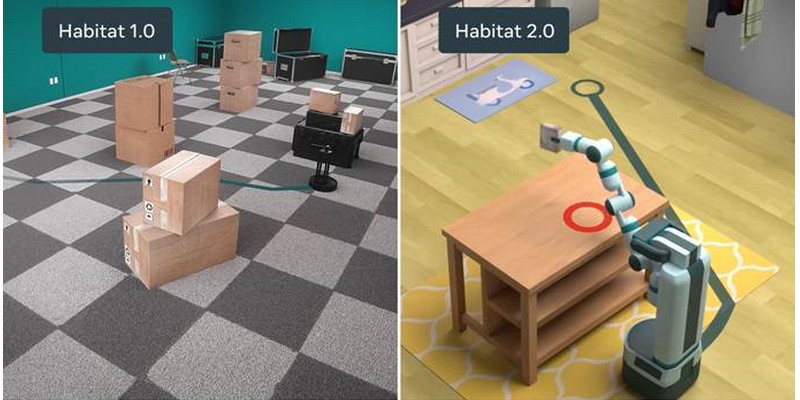
A simulator that trains AI models to perform domestic tasks
As part of its annual event, FAIR presented Habitat 2.0, the second version of its Habitat simulator, which aims to enable AI models for robotics or for the development of personalized virtual assistants to be trained in interactive environments and at much faster speeds than its predecessor Habitat 1.0. Habitat 2. 0 also includes a new fully interactive 3D dataset of interior spaces. It also includes new references for virtual robot training. With this dataset and new platform, AI researchers and experts can go beyond simply creating virtual agents in static 3D environments. The tool helps them design robots that can perform household tasks that we humans can do on a daily basis, such as putting our dishes in a dishwasher, putting away our refrigerator, or placing and retrieving items on a dresser.Facebook AI Research teams up with environment capture specialist Matterport
To design these 3D environments, FAIR is collaborating with Matterport, a company that specializes in environment capture. Together, they have designed a collection of 1,000 environments that are freely available for research. This set of environments is called the Habitat-Matterport 3D Research Dataset (HM3D) and includes many spaces: municipal, commercial, residential. These environments have been generated using images of real places: they have exploited the five million spaces scanned by the firm since its inception. HM3D is already available and has been designed to work with Habitat 2.0. Facebook states:"We hope that the Habitat-Matterport 3D Research Dataset (HM3D) will bring researchers closer to creating AI agents - virtual robots or personal assistants - that can be safely trained on a large scale and reproducibly in a simulation."
A tool that is faster and more powerful in its simulation capabilities
FAIR's research teams have designed this new version ofHabitat with a focus on the speed and performance of its platform, and thus, provide a broader portfolio of simulation capabilities to help the research community test new approaches. For example, rather than simulating wheel/ground contact, researchers used a navigation mesh to move the robot. At present, the platform does not support non-rigid dynamics such as liquids, fabrics, ropes, or audio or tactile sensing. However, experts using Habitat 2. 0 will be able to perform complex tasks that have been nearly impossible to achieve. The speed offered by the platform allows for a significant reduction in experimentation time: expert users will be able to complete their tests in two or three days, compared to almost six months previously. This reduced time could be the way to much faster innovation and progress in the field. In the future, Habitat will seek to model spaces that have not yet been modeled or take into account cultural and regional differences in furniture and their placement within a room or space. Although Habitat 2. 0 is already very powerful, FAIR wants to improve its platform by focusing on aspects related to the management of environments for example. Translated from Facebook AI Innovation Summit : Habitat 2.0, un simulateur pour aider les robots dans les tâches domestiques
Our articles will then appear first in Google Top Stories.