

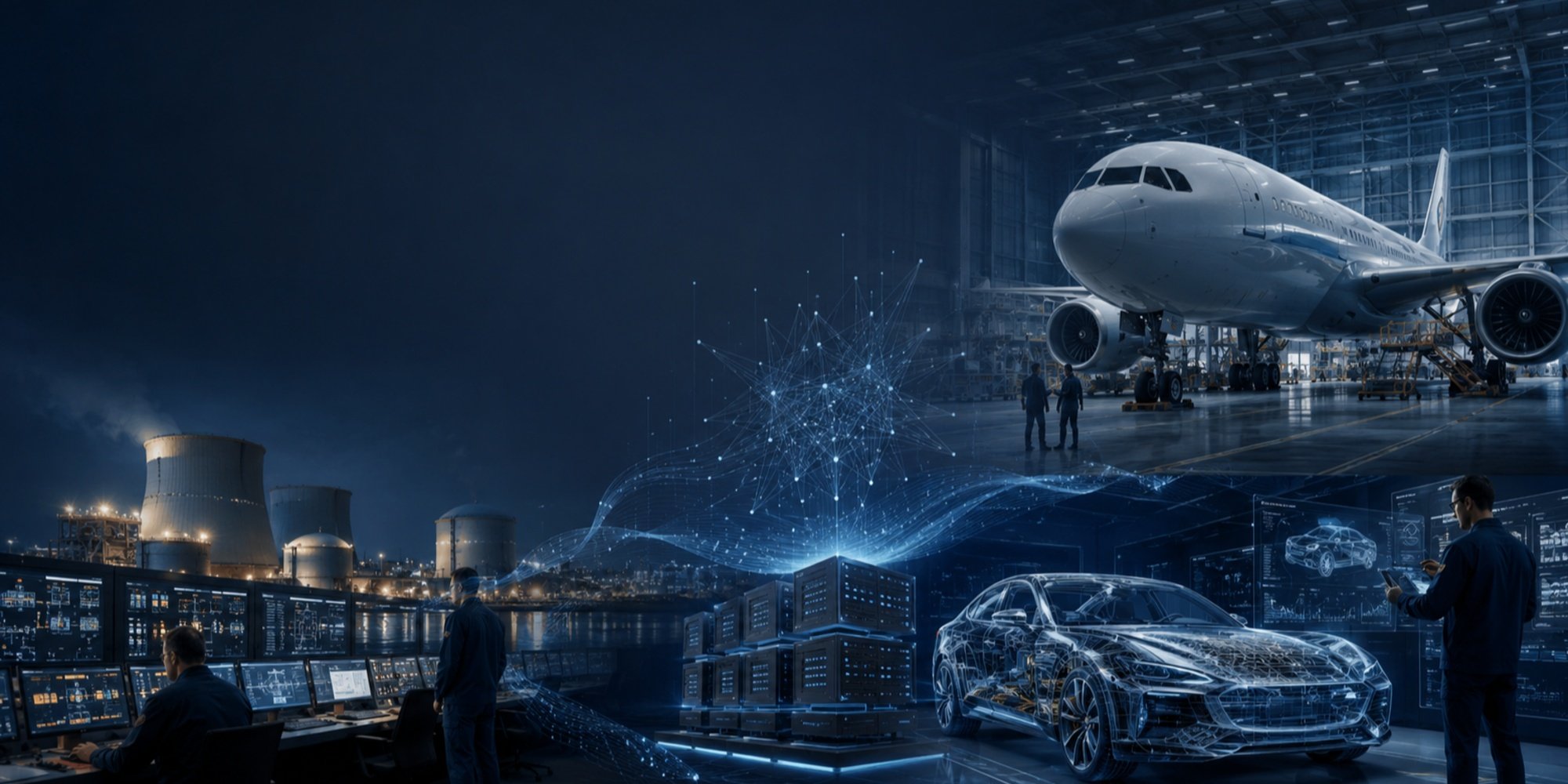
Mistral AI took advantage of its AI Now Summit, held on May 28, 2026, at the Carrousel du Louvre, to showcase a new significant industrial phase. Within a day, the French start-up highlighted partnerships with EDF, BMW, and Airbus, three world-leading regulated groups in energy, automotive, and aeronautics. For the company founded in 2023 by Arthur Mensch, Guillaume Lample, and Timothée Lacroix, the challenge is no longer just to demonstrate the performance of its models but to show its ability to integrate into the critical systems of major European industries.
At EDF, the partnership focuses on using AI for nuclear service, engineering, and digital sovereignty. The agreement, announced for a duration of five years, aims to accelerate certain engineering processes, support projects related to future EPR2, and develop generative AI solutions adapted to the constraints of the French energy group.
Airbus, on its part, has signed a partnership with Mistral AI to enhance the use of artificial intelligence in its activities, from design to onboard capabilities. The agreement covers commercial airplanes, helicopters, defense, and space, with an emphasis on applications considered ethical, reliable, and sovereign.
BMW also announced a collaboration with Mistral AI, focused on crash simulations and vehicle development. The stated goal is to use AI to accelerate complex engineering processes, improve the exploitation of simulation archives, and enhance the accuracy of safety tests.
A Growing Industrial Portfolio
This EDF-BMW-Airbus sequence is part of a strategy already initiated with major industrial clients. Mistral AI now counts among its partners or clients groups like Stellantis, TotalEnergies, CMA CGM, SNCF, Siemens, Veolia, or even ASML, which entered its capital in September 2025 during a 1.7 billion-euro fundraising that valued the company at 11.7 billion euros.
The message is clear: Mistral aims to be a European alternative to American AI platforms, not only on the model layer but also on industrial applications, infrastructures, and data sovereignty. This positioning is particularly evident in regulated sectors where security, hosting, governance, and compliance constraints weigh more heavily than in consumer applications.
However, behind the announcement effect, financial information remains limited. As of May 28, 2026, the EDF, BMW, and Airbus agreements were not accompanied by detailed public amounts. Operational scopes are described, but contractual volumes, deployment timelines, and financial commitments have not been communicated.
Caisse des Dépôts, Main Identified Publicly Priced Contract
At this stage, the main publicly priced contract around Mistral AI's solutions in France remains the Caisse des Dépôts framework agreement, awarded to the Sopra Steria-Computacenter consortium. The agreement, with a maximum duration of four years, represents a potential amount reaching 140 million euros excluding VAT. It benefits the purchasing group formed around Caisse des Dépôts, including notably Bpifrance and several group subsidiaries.
According to ChannelNews, this contract aims for the initial deployment of 40,000 Mistral AI licenses, with a trajectory that could go up to 100,000 users. The scope concerns 19 entities, including La Banque Postale, Bpifrance, CNP Assurances, and La Poste.
This contract provides a rare benchmark in a market where enterprise AI announcements are often framed in terms of partnerships, experiments, or gradual deployments. It thus serves as a useful gauge for measuring Mistral AI's commercial transformation: the transition from a company renowned for its models to a provider of integrated solutions for large public and private accounts.
From Models to Applications: The Assumed Repositioning
Mistral AI's trajectory illustrates a broader market evolution. While the first phase of generative AI was dominated by the race for foundational models, the value is gradually shifting towards application layers, business integration, security, infrastructure, and the ability to deploy AI in constrained industrial environments.
This shift does not imply abandoning the technological race. Mistral continues to develop its models and invest heavily in infrastructure. The company raised $830 million in debt in March 2026 to fund European computing capabilities, including a site in Bruyères-le-Châtel equipped with 13,800 Nvidia GB300 GPUs and endowed with 44 MW of power.
This infrastructure aims to reduce operational dependency on third-party clouds and offer European clients more controlled environments. However, it does not eliminate all technological dependency: Nvidia silicon remains at the heart of the system, as it does for almost the entire frontier AI ecosystem.
An Industrial Strategy Not Unique to Mistral
The movement initiated by Mistral AI is not isolated. Anthropic announced in May 2026 a strategic partnership with Hitachi covering approximately 290,000 employees of the Japanese group. The agreement provides for the deployment of Claude in the group's internal processes, as well as developments around critical sectors like energy, transport, industry, finance, or cybersecurity.
The sectoral logic is therefore comparable: integrating advanced AI models into large industrial organizations, as close as possible to the business, data, and operational constraints. The difference lies more in the strategic framing. While Anthropic emphasizes productivity, business transformation, and frontier AI, Mistral AI focuses more on European sovereignty, hosting, security, and managing technological dependencies.
This sovereign positioning is not merely rhetorical. It responds to a real demand from major European accounts, notably in public, financial, industrial, and sensitive sectors. But it is not enough, on its own, to differentiate the industrial approach: the main AI players are now all seeking to build sectoral verticals, integrated offerings, and partnerships with large groups.
A Demonstration of Credibility, Not Yet Complete Commercial Transparency
The AI Now Summit marks an important milestone for Mistral AI. By aligning EDF, BMW, and Airbus in the same public sequence, the company shows that it is no longer just an actor of open or performant models but a supplier capable of convincing regulated, demanding, and strategic industries.
One limitation remains: the most visible announcements are not always the most financially documented. The industrial partnerships strengthen Mistral's commercial credibility, but they do not yet allow for precise evaluation of the associated revenues. To date, the Caisse des Dépôts agreement remains the main publicly quantified benchmark to appreciate the scale of deployments around its solutions in France.
The May 28, 2026 sequence thus confirms less a rupture than an acceleration: Mistral AI seeks to transition from being a European champion of models to an industrial AI sovereign platform. Its ability to transform these announcements into recurring revenues, measurable deployments, and sustainable operational references will now be the true test.

Our articles will then appear first in Google Top Stories.