

Ljubisa Bajic, co-founder and CEO of Taalas, presented the Toronto-based company's first chip in February. Twenty-four people had designed it for $30 million, out of more than $200 million raised. On 17 November 2026, AMD completed the acquisition of Taalas announced in August, and its quarterly report values the deal at about $2.9 billion, in cash and stock. Up to about $1.4 billion of that amount is contingent.
The same document associates Taalas with World Labs, whose all-stock acquisition is valued at about $8.2 billion. Both deals are meant to strengthen AMD's research on models, its inference capabilities and the development of hardware and systems for a "future superintelligence". At this price, AMD is buying a method and a team. Taalas's only product, the HC1, is listed on its products page as a technology demonstrator.
Taalas etches model weights into the circuit
On a GPU, a model's weights, those billions of parameters set by training, reside in fast memory placed next to the processor, HBM, and travel to the compute units for every token, those word fragments the model produces one by one. Taalas eliminates this journey by combining storage and compute on the same chip. Its design does without HBM and liquid cooling, wrote Ljubisa Bajic in the launch post of 19 February.
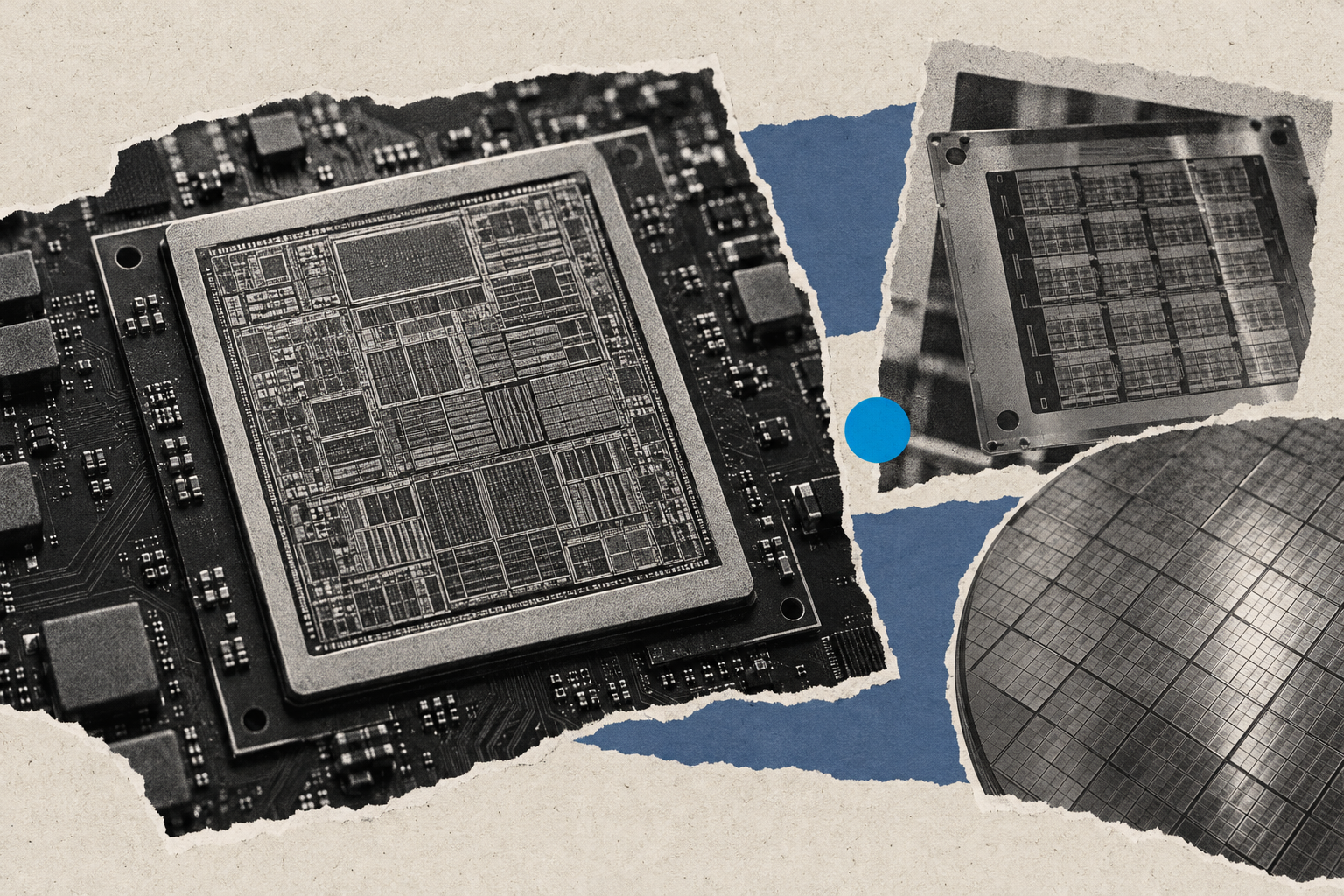
The weights are written into a read-only memory programmed by the manufacturing masks. They are etched with the circuit and cannot be rewritten. Next to it, a rewritable SRAM area holds the context cache, which avoids recalculating what the model has already read for each token, and LoRA adapters, those small sets of weights that specialise a model without retraining it, Paresh Kharya, vice president of products, told The Next Platform. A single transistor stores four bits and performs the associated multiplication, claims Ljubisa Bajic, who keeps the process to himself.
The HC1, etched in 6 nm at TSMC, measures 815 mm², almost the maximum area of a single die. It carries Llama 3.1 8B, an open model from Meta that Taalas admits is "clearly not state of the art".
The 17,000 tokens per second come from Taalas's labs
Taalas claims 17,000 tokens per second per user on this model, nearly ten times the state of the art, for hardware twenty times cheaper to build and ten times less energy-hungry. According to the caption of its chart, the company measured its chip and Nvidia's B200 GPU in its own labs, and took the values for Groq, SambaNova and Cerebras from the independent comparator Artificial Analysis.
On that comparator, heise online found for the same model about 1,936 tokens per second at Cerebras, 916 at SambaNova and 609 at Groq. Its journalists reached nearly 16,000 tokens per second on Taalas's demo chatbot, noting that all published benchmarks came from the company. On a small model, the speed advantage is hardly in doubt.
Quality is less documented. The etched model's parameters are stored on 3 and 6 bits, a reduced precision that causes quality losses compared to GPU measurements, Taalas acknowledges, without quantifying them. Its second generation, HC2, is to adopt a standard 4-bit floating-point format.
Changing models means making a new chip
The chip retains some flexibility: the context window size is configurable, and LoRA adapters allow fine-tuning the model. Beyond that, the circuit must be redone. "You're stuck with that model", summed up The Register on 6 August, as new models come out almost every month.
Taalas responds with its own figures for time and cost. Two months would be enough to go from the weights of an unknown model to cards capable of serving requests, and only two metal layers change from one model to another. Training a model costs a hundred times more than a custom chip ordered in volume, Paresh Kharya said in February.
The risk of obsolescence falls on whoever orders the silicon. The Register expects the technology to be deployed mainly by model developers, their infrastructure providers and a handful of inference providers. These are the players who know which model they will serve, and for how long.
AMD wants to pair these chips with its Instinct GPUs
AMD reiterated on 17 November that it would integrate Taalas's technology into its accelerator roadmap and develop system-level solutions alongside its Instinct GPUs, without naming a product or a date. The Register gave a reading in August that the company has not confirmed. AMD would pair its Helios racks, built on Instinct GPUs, with chips derived from Taalas: the GPUs would process the prompt, the most compute-intensive step, and Taalas's accelerators would produce the tokens. The site also envisaged customers first validating a model on GPUs before having it etched.
This division of labour already exists at Nvidia, whose LPX systems pair GPUs with Groq chips, the same article noted. Cerebras put into production on 17 November a so-called disaggregated inference, where AMD Instinct GPUs process prompts and its CS-3 systems generate responses. With Taalas, AMD can itself provide the generation stage that Cerebras adds to Instinct GPUs, with a circuit dedicated to each model.
The bet holds for AMD, whose GPUs remain the tool of those who change models often. Taalas's chip will only sell where a model stays in service long enough to amortise its etching.
Quotes translated from English by ActuIA.

Our articles will then appear first in Google Top Stories.