

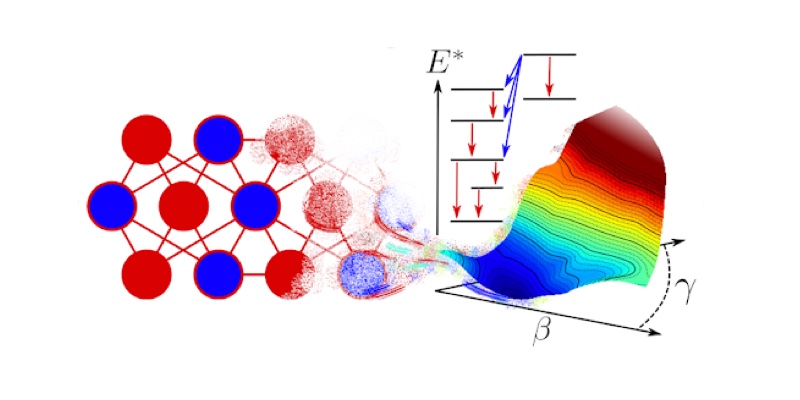
The work of Raphaël-David Lasseri, David Regnier, Jean-Paul Ebran and Antonin Penon, theoreticians at the CEA, Irfu at the DRF (Espace de Structure Nucléaire Théorique) and the Nuclear Physics Department at the DAM, was published this year in the journal Physical Review Letters , the article is among the suggestions of the editor. The researchers have developed an artificial intelligence for predicting the properties of the atomic nucleus. They have simulated the properties of more than 1800 atomic nuclei using an algorithm trained on a subset of only 210 nuclei.
These 210 kernels were chosen automatically by the AI using a so-called active learning approach, a first. This is a major advance compared to previous approaches that were limited to the prediction of a single observable (measurable physical quantity, such as mass) and had a very low predictive range. The results obtained are of a precision comparable to that of calculations based on the state of the art techniques used in theoretical nuclear physics, and this in a significantly reduced calculation time (a gain ranging from a factor of 10 to a factor of 10³ depending on the type of result desired).
Understanding the structure and limit of existence of atomic nuclei is an essential and difficult issue. It is however necessary to determine the origin of heavy elements in our galaxy as well as to discover new super-heavy elements. Motivated by the rapid progression of machine learning over the last 10 years, the study aimed to examine, for the first time, the ability of an AI to grasp the physics of low-energy nuclear structures as a whole.
Energy Density Functionals: A Proven Theoretical Approach
Among the various theoretical approaches to provide a universal description of nuclear observables, such as the mass, radius or excitation energy spectrum of a nucleus, only the Energy Density Functional (EDF) framework is currently able to provide a complete and accurate description of the properties of the atomic nucleus.
This theoretical approach describes the interactions between nucleons, i.e. the protons and neutrons making up the nucleus, as a function of the density of the system. In particular, the most recent approaches, known as Multi-Referenced EDF (MR-EDF), provide accurate and universal observable predictions at the expense of a very consequent increase in computation time.
[caption id="attachment_25575" align="alignnone" width="1000"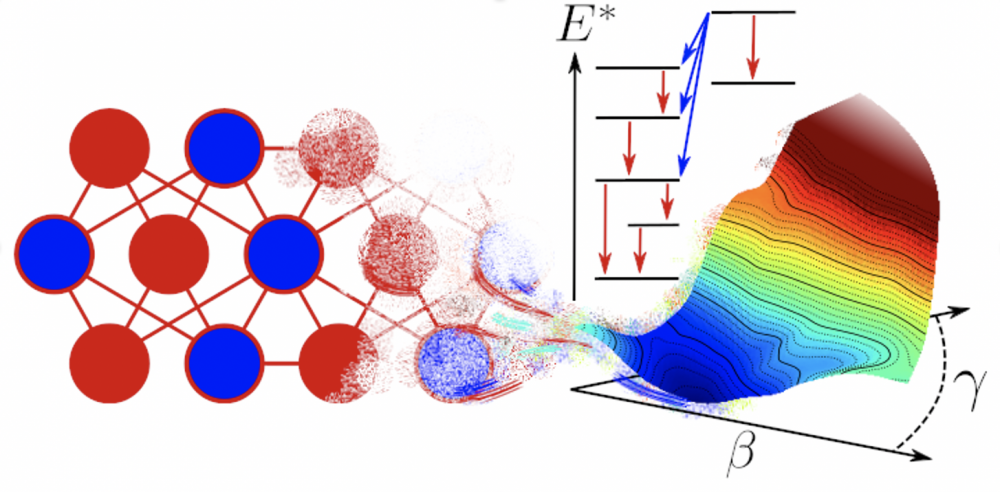 Figure 1. Illustration des calculs opérés par les réseaux de neurones, de la spectroscopie nucléaire - ici représentée par un schéma des niveaux d’énergie d’excitation (E*) du noyau - aux surfaces d'énergie potentielle qui représente l’énergie du noyau en fonction de paramètres de déformation ( β et γ).[/caption]
Aussi, le déploiement à grande échelle des EDF nucléaires est associé à un coût numérique lourd, se traduisant par des temps de calculs particulièrement conséquents (à titre d’exemple, pour calculer l’ensemble des propriétés nucléaires sur l’ensemble de la carte il faut quelques millions d’heures CPU). Un tel coût est prohibitif dans plusieurs situations, par exemple dans le cas d’une étude systématique de la variation des observables prédites sur l’ensemble de la carte nucléaire en fonction de différentes paramétrisations de l’interaction EDF (étude particulièrement importante pour des applications astrophysiques, comme l’étude de la nucléosynthèse primordiale nécessitant le calcul de larges volumes de données nucléaires pour plusieurs centaines d’isotopes). Ainsi, l’ajustement d’une interaction au niveau MR-EDF n'a finalement été entrepris qu'une seule fois jusqu’à présent (travail réalisé par des équipes du CEA DAM).
Pour pallier à ce problème, des approches numériques alternatives ont été proposées, en particulier certaines faisant appel à l’IA.
]The first steps of AI for the nuclear structure
As early as 2006, Athanassopoulos and his collaborators proposed to use a simple neural network to predict nuclear mass tables. This initial study was not intended to be predictive over a wide range of the kernel map. It predicted only 10% of them, with 90% of the experimental mass measurements being used to train the neural network. However, these predictions were relatively accurate with a mean deviation from the experiment of 950 keV (i.e. a deviation from the experiment of about 1% for Oxygen 16 for example). Moreover, modulo the numerically heavy training phase (carried out in a few hours on a graphical map/GPU), the prediction phase of unknown masses (the neural network inference) is much faster than a classical EDF calculation.Since then, several studies have followed the pioneering work of Athanassopoulos, but they all have two common features that considerably limit their scope, i) The use of a large amount of data for the training phase of neural networks (of the order of 80% of the available data) ii) The focus on a single predicted experimental observable (mainly mass or radius of the nucleus). In this respect, these AI approaches are limited to interpolating (or extrapolating) some experimental measurements and are therefore not competitive with the results of the EDF approaches.
A new approach
CEA researchers have therefore proposed a new approach: an algorithm that does not learn one observable but several intermediate quantities calculated by a conventional EDF code. For example, quantities quantifying the way in which cores respond to deformations or vibrations. The idea is, that by providing a sufficient representation of the various possible physical behaviors of the kernel, we will allow this neural network to learn a complete representation, thus going beyond the simple interpolation of experimental results.Contrary to previous approaches, one of the requirements of this study was to minimize the fraction of cores used for training, by limiting itself to 10% (or 210 cores) of the available cores. Moreover, the constitution of this set of cores used for training poses a question of major physical interest. What are the most important nuclei to transcribe low-energy nuclear physics as a whole?
To answer this question in a comprehensive way, a so-called active learning approach has been developed. The objective of this method is to automatically determine which cores of the training set provide the most information to the neural network in order to maximize its predictive power. Here, a neural network committee (a set of neural networks whose initial parameters are randomly drawn, like a generalized Monte-Carlo method) is used to iteratively construct one of the 210 kernel sets that gives the best prediction on the remaining 90% of the kernels to be predicted. Then this set of kernels is used to train the neural network to predict the physical variables from an EDF theory. Finally, the quantities predicted by the networks are pooled to predict all the observables of interest for the study of the nuclear structure, for example the energies of the first excited states of any nucleus.
[caption id="attachment_25574" align="alignnone" width="1000"]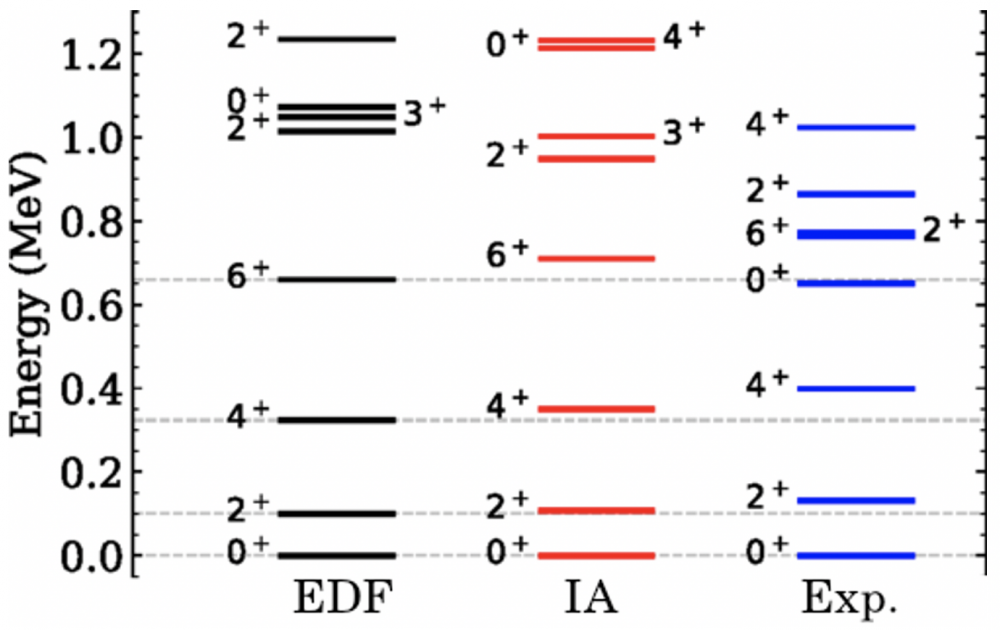 Figure 2 : Spectre d'excitation de l’178Os (composé de Z = 76 protons et N = 102 neutrons) obtenu à partir des calculs IA (AI) et EDF . Le spectre expérimental (Exp.), extrait de la base de données ENSDF est également représenté.[/caption]
Results
For the first time ever, an algorithm consisting of a neural network committee was able to estimate the low-energy structure of all nuclei. Remarkable performances are obtained, e.g. a value of the mean energy deviation of the EDF fundamental states of only 716 keV (rms) (i.e. less than 0.5 % error for Osmium 178).This for a training set of only 210 nuclei automatically selected as the most representative of the physics of the whole nuclear map. Moreover, the distribution of the automatically selected nuclei is globally consistent with the physical intuition with an important representation of light nuclei and nuclei close to drip-lines.
Finally, it is important to note that once the network has been trained on all the drive cores, the prediction of all the observables on the whole map takes only a few milliseconds compared to several hundred CPU hours in case of direct EDF calculation. It is therefore now possible to perform only ~200 EDF calculations before being able to generalize the results of a functional on the whole map while keeping a very good accuracy compared to the experiment.
[caption id="attachment_25576" align="alignnone" width="696"]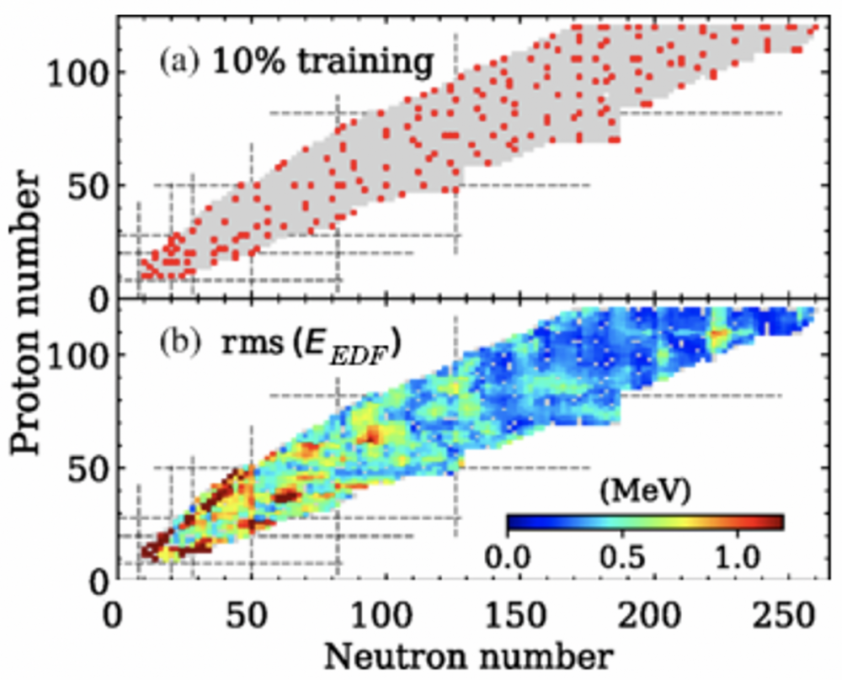 Figure 3 : En panel (a) les points rouges représentent les noyaux composant l'ensemble d'entrainement obtenus par apprentissage actif. En panel (b) la répartition sur la carte de l'écart moyen sur l'énergie de l'état fondamental entre l'énergie prédite par l'IA et celle servant de référence EDF.[/caption]
A promising future for IA approaches to nuclear structure
This work now paves the way for many improvements and uses of AI algorithms for the theoretical description of atomic nuclei. Firstly, in view of the consequent gain in computing time, it is now possible to use these algorithms to rapidly build new EDFs taking into account a large number of experimental observables (masses, radii, but also characteristics of the ground state and excited states).This approach is particularly important for astrophysical applications and is already being evaluated by a Franco-Belgian collaboration. Beyond these direct applications, it is also becoming possible to use neural networks to provide good quality starting points for nuclear dynamics calculations, particularly for the study of fission.
Finally, the success of this approach is a first proof of principle that a neural network committee is capable of coding several correlated aspects of nuclear deformation. The neural networks involved probably have a satisfactory non-trivial internal representation of the physics of the system. The study of this representation may reveal new physical concepts that are captured during learning.
On a larger scale, the information that can be extracted from an AI algorithm about the representation of a complex physical problem is a key issue at the intersection of physics and representation theory.
Reference
1] R&D. Lasseri, D. Regnier, J-P. Ebran, and A. Penon, Phys. Rev. Lett. 124, 162502 (2020)Contacts
Raphaël LasseriDavid Regnier
Translated from Des chercheurs ont développé une intelligence artificielle permettant la prédiction des propriétés du noyau atomique