

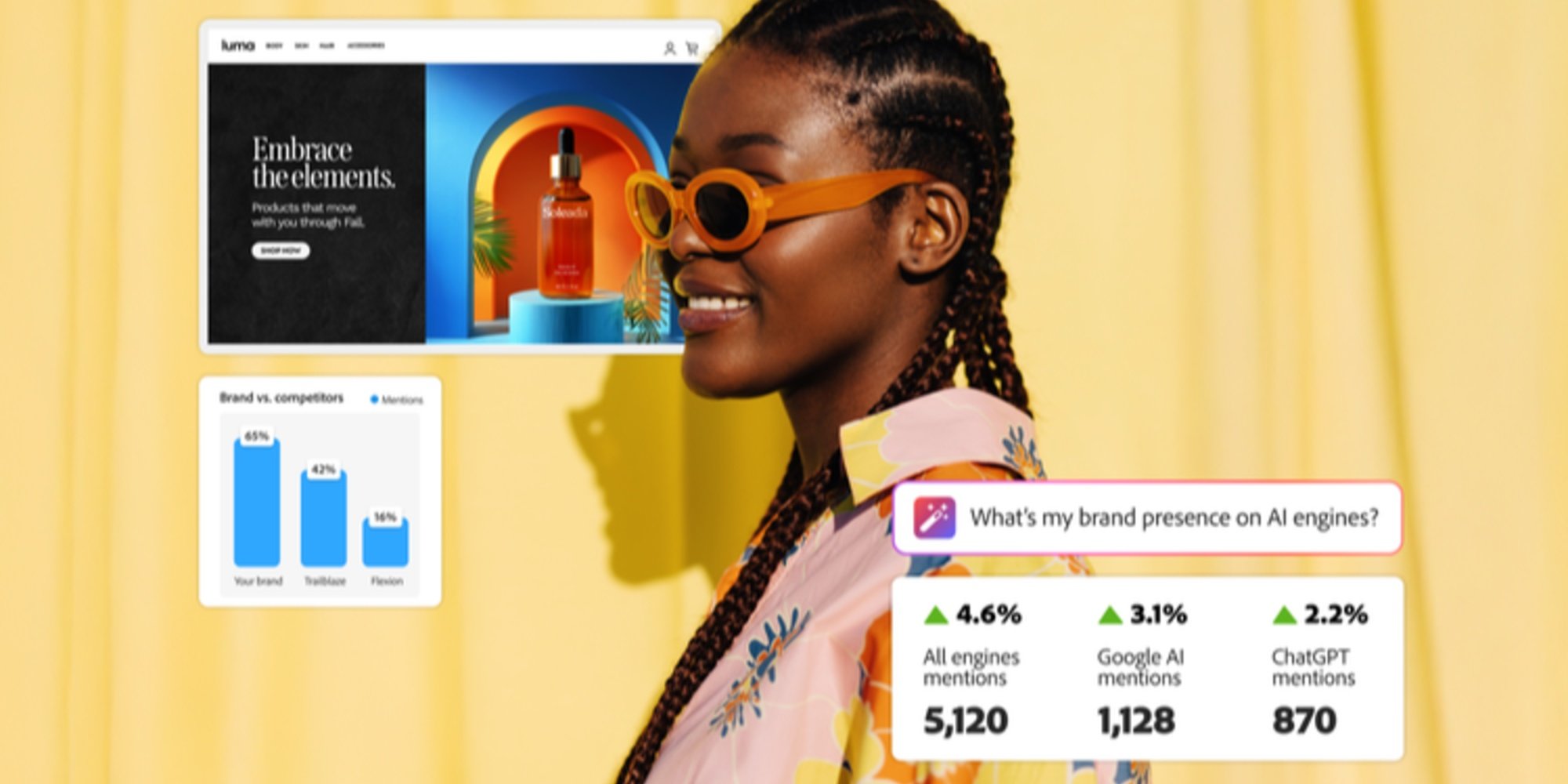
TLDR : Adobe launches LLM Optimizer to help brands navigate the shift towards AI-powered search, allowing them to measure, improve, and govern their visibility in generative AI environments.
With the rise of conversational assistants and search engines powered by language models like ChatGPT, Claude, or Gemini, a transformation is occurring in how consumers discover, evaluate, and interact with brands. Adobe anticipates this shift with the launch of LLM Optimizer, a solution designed to enable businesses to measure, improve, and govern their presence in AI-optimized search environments.
Traditional search is gradually giving way to interactions with LLMs, profoundly altering traffic acquisition strategies for brands. Insights from Adobe Analytics, based on actual online transactions, show a 3200% increase in traffic to travel sites and a 3500% increase to US retail sites between July 2024 and May 2025 from generative AI sources.
Loni Stark, Vice President of Strategy and Products at Adobe Experience Cloud, states:
"Generative AI-powered interfaces are becoming key touchpoints throughout the customer journey, from discovery to engagement to purchase decisions. With Adobe LLM Optimizer, we enable brands to confidently approach this new environment, ensuring they stand out and capture decisive moments."
LLM Optimizer allows you to:
-
Map brand visibility in generative responses;
-
Identify content opportunities to appear in AI recommendations;
-
Optimize commercial performance from these new traffic sources.
Its operation revolves around three pillars:
- Monitoring traffic and visibility in AI environments: the tool detects content used by conversational assistants to formulate their responses, providing brands with a real-time view of their presence in these interfaces. A benchmarking feature allows measurement of this visibility against competitors, particularly on high-value strategic queries;
- Performance-oriented actionable recommendations: beyond diagnostics, LLM Optimizer suggests concrete actions: enriching an FAQ, enhancing a product page, or strengthening presence on third-party platforms like Wikipedia. The recommendation engine leverages analysis of attributes highlighted by language models (structure, clarity, reliability...) and links each recommendation to key business indicators (traffic, engagement, conversion);
- Rapid implementation via CMS or API integrations: designed for SEO, content, or digital marketing teams, LLM Optimizer integrates with Adobe Experience Manager Sites but can also operate independently. It supports emerging protocols such as Agent-to-Agent (A2A) or Model Context Protocol (MCP), facilitating its adoption in diverse technical environments.
This ability to act on owned (sites, FAQs) and earned content (Wikipedia, forums, knowledge bases) offers a new form of optimization: proactive, contextualized, and tailored to synthesis algorithms.