

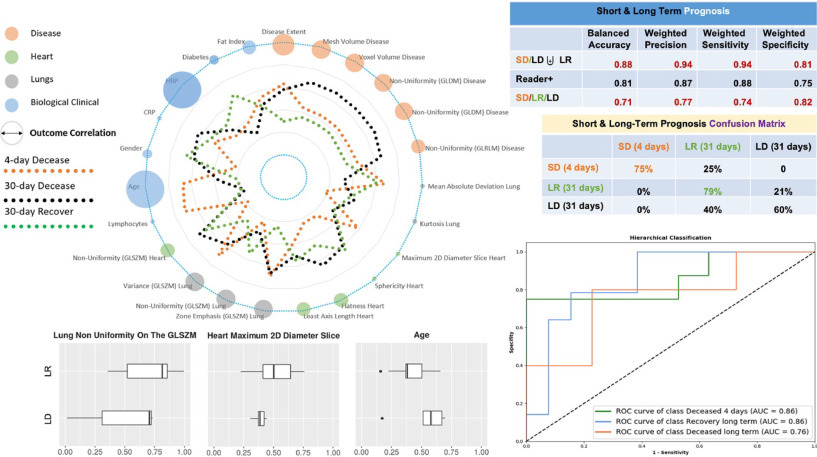
Researchers and doctors from Gustave Roussy, Assistance Publique-Hôpitaux de Paris, CentraleSupélec, Université de Paris, Université Paris-Saclay, Inserm, Inria and TheraPanacea worked on a study on the prediction of the gravity of Covid-19 using artificial intelligence (AI). Published in Medical Image Analysis last month, this study shows that an AI can extract clinical and biological information from scanner images to establish the severity of the disease and the prognosis of patients with Covid-19.
35 specialists, doctors and researchers from Gustave Roussy, Assistance Publique-Hôpitaux de Paris, CentraleSupélec, University of Paris, University Paris-Saclay, Inserm, Inria and TheraPanacea took part in a study on the anticipation of acute complications of Covid-19. The results of their research, published in the journal Medical Image Analysis, show that there is a digital signature of biomarkers predictive of the evolution of Covid-19. By identifying patients at risk of developing severe forms and requiring ventilation assistance, this AI could help hospitals to prioritize patient management according to their vital urgency.
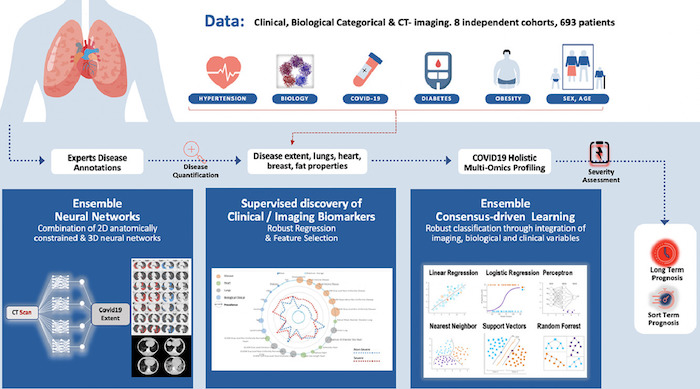
Chest CT is widely used for the management of coronavirus pneumonia. In addition to helping to diagnose the disease, it plays a prognostic role by visually assessing the extent of lung damage. In this retrospective study, doctors and researchers developed an end-to-end artificial intelligence solution that allows an experienced radiologist to quantify Covid-19 as accurately as an experienced radiologist, to assess the severity of the disease and its short-term prognosis.
The AI was trained and validated on the CT images of 478 patients from five independent cohorts who had previously been diagnosed with Covid-19 by RT-PCR. The patient group studied had 110 severe cases, 6% of whom died from Covid-19 and 17% of whom were intubated.
Using a deep learning approach that exploits 2D and 3D convolutional neural networks, the researchers taught AI to automatically recognize areas where the disease was characteristic (frosted glass structure) on scanner images. To do this they used a dataset of more than 20,000 scanner slices annotated by 15 independent and experienced radiologists. The algorithm then determined 10 clinically interpretable biomarkers based on the extent and heterogeneity of the disease, lung involvement and cardiac preservation.
By correlating these biomarkers with patient age and gender and clinical data, RN has learned through a set of supervised classification methods to assess disease severity and short-term prognosis of patients, and thus identify those who will develop severe symptoms associated with respiratory and resuscitation needs.
It would also be of interest to propose early, and to avoid the need for resuscitation, drugs currently being evaluated in severe forms of Covid-19.
"The work is ongoing and a permanent enrichment of the dataset is planned. 11,000 scanners that will very soon be integrated have already been annotated as part of the STOIC project promoted by AP-HP and coordinated by Pr Marie-Pierre Revel of the AP-HP Cochin Hospital. Thanks to the AI.Dream project financed by Bpifrance, a clinical deployment is planned in 2021 in partnership with GE Healthcare", concludes Pr Nikos Paragios at CentraleSupélec/University Paris-Saclay, President of TheraPanacea, and member of the PRISM National Center for Precision Medicine.AI-Driven CT-based quantification, staging and short-term outcome prediction of COVID-19 pneumonia , Medical Image Analysis, advanced online publication October 15, 2020
https://doi.org/10.1016/j.media.2020.101860
Guillaume Chassagnon, Maria Vakalopoulou, Enzo Battistella, Stergios Christodoulidis, Trieu-Nghi Hoang-Thi, Severine Dangeard, Eric Deutsch, Fabrice Andre, Enora Guillo, Nara Halm, Stefany El Hajj, Florian Bompard, Sophie Neveu, Chahinez Hani, Ines Saab, Alienor Campredon, Hasmik Koulakian, Souhail Bennani, Gael Freche, Maxime Barat, Aurelien Lombard, Laure Fournier, Hippolyte Monnier, Teodor Grand, Jules Gregory, Yann Nguyen, Antoine Khalil, Elyas Mahdjoub, Pierre-Yves Brillet, Stephane Tran Ba, Valerie Bousson, Ahmed Mekki, Robert-Yves Carlier, Marie-Pierre Revel, Nikos Paragios
- Radiology Department, Cochin Hospital - AP-HP. Centre Université de Paris, 27 Rue du Faubourg Saint-Jacques, Paris 75014, France
- University of Paris, 85 boulevard Saint-Germain, Paris 75006, France
- Inserm U1016, Institut Cochin, 22 rue Méchain, Paris 75014, France
- Université Paris-Saclay, CentraleSupélec, Mathematics and Computer Science for Complexity and Systems, Gif-sur-Yvette, France, 3 Rue Joliot Curie, Gif-sur-Yvette 91190, France
- University of Paris-Saclay, CentraleSupélec, Inria, Gif-sur-Yvette, France
- Gustave Roussy-CentraleSupélec-TheraPanacea, Noesia Center of Artificial Intelligence in Radiation Therapy and Oncology, Gustave Roussy Cancer Campus, Villejuif, France
- Université Paris-Saclay, Institut Gustave Roussy, Inserm U1030 Molecular Radiotherapy and Innovative Therapeutics, 114 Rue Edouard Vaillant, Villejuif 94800, France
- Université Paris-Saclay, Institut Gustave Roussy, Inserm U981 Predictive Biomarkers and New Therapeutic Strategies in Oncology, 114 Rue Edouard Vaillant, Villejuif 94800, France
- Université Paris-Saclay, Institut Gustave Roussy, Prism Precision Medicine Center, 114 Rue Edouard Vaillant, Villejuif 94800, France
- TheraPanacea, 27 Rue du Faubourg Saint-Jacques, Paris 75014, France
- Radiology Department, Georges Pompidou European Hospital - AP-HP. Centre Université de Paris, 20 Rue Université Paris-Saclay, Paris 75015, France
- Radiology Department, Beaujon Hospital - AP-HP. Nord Université de Paris, 100 Boulevard du Général Leclerc, Clichy 92110 France
- Internal Medicine Department, Beaujon Hospital - AP-HP. Nord Université de Paris, 100 Boulevard du Général Leclerc, Clichy 92110 France
- Radiology Department, Bichat Hospital - AP-HP. Nord Université de Paris, 46 Rue Henri Huchard, Paris 75018, France
- Radiology Department, Avicenna Hospital - AP-HP. Hopitaux universitaires Paris Seine-Saint-Denis, 125 Rue de Stalingrad, Bobigny 93000, France
- Université Sorbonne Paris Nord, 99 Avenue Jean Baptiste Clément, Villetaneuse 93430, France
- Radiology Department, Lariboisière Hospital - AP-HP. Nord Université de Paris, 2 Rue Ambroise Paré, Paris 75010, France
- Radiology Department, Ambroise Paré Hospital - AP-HP. Université Paris Saclay, 9 Avenue Charles de Gaulle, Boulogne-Billancourt 92100 France
- Radiology Department, Raymond-Pointcaré - AP-HP. Université Paris Saclay, 104 Boulevard Raymond Poincaré, Garches 92380, France
- Université Paris-Saclay, Espace Technologique Bat. Discovery - RD 128 - 2nd ét, Saint-Aubin 91190 France
Translated from Des chercheurs utilisent le deep learning et les réseaux neuronaux convolutifs 2D et 3D pour prédire le degré de gravité de la Covid-19