

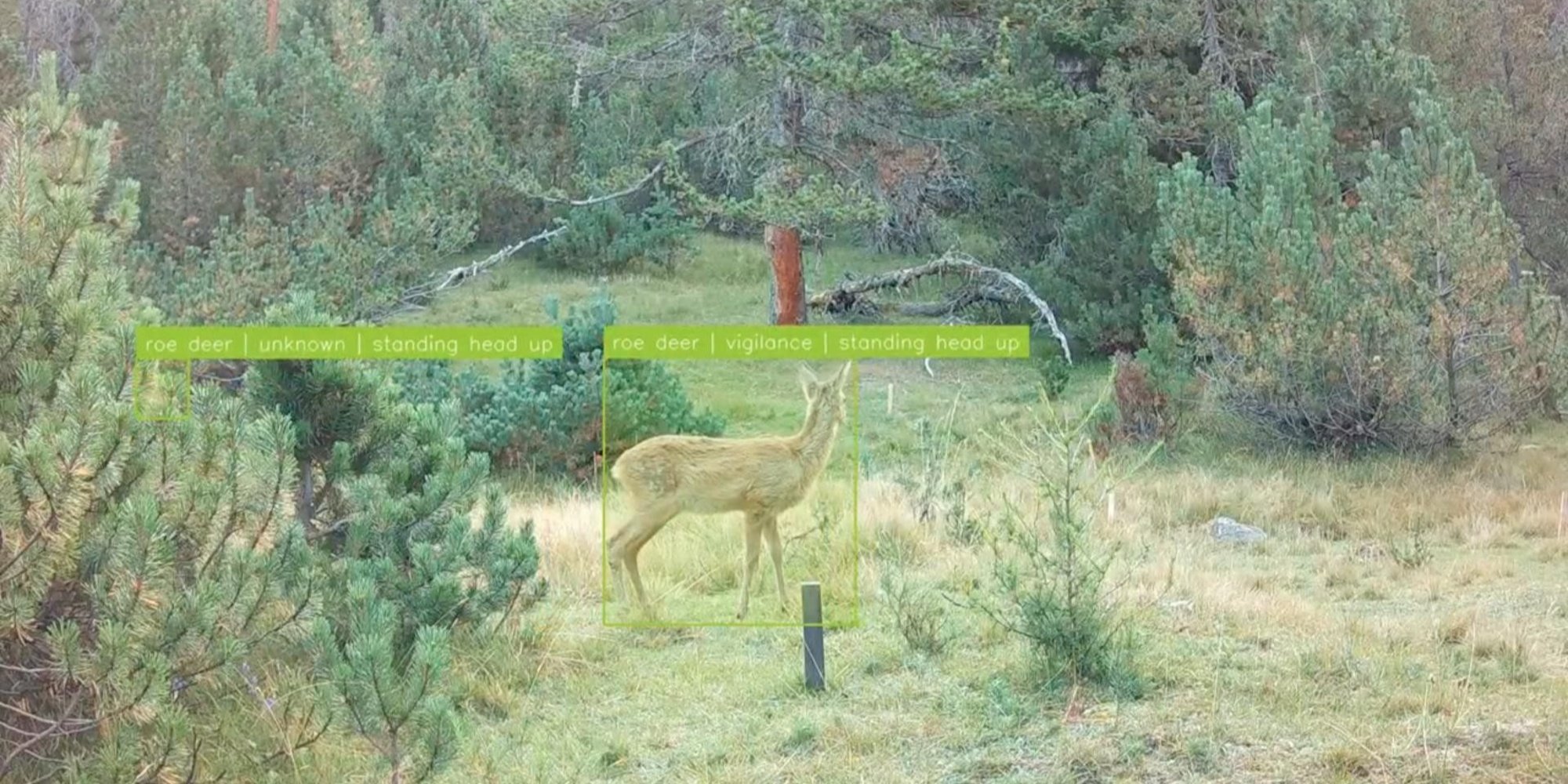
A team of researchers from the École polytechnique fédérale de Lausanne (EPFL) presented MammAlps at CVPR 2025, a project combining computer vision, behavioral ecology, and non-intrusive wildlife observation. The initiative, conducted in partnership with the Swiss National Park, aims to better understand the behaviors of alpine mammals through a unique set of multimodal video data.
Understanding wildlife behavior is essential to anticipate the impacts of climate change or human activity on ecosystems. Camera traps, less intrusive than direct observation or sensor tagging, allow for studying animals without disturbing them. However, manual analysis of the images they generate is time-consuming and partial.
The EPFL team, led by PhD student Valentin Gabeff and supervised by Professors Alexander Mathis and Devis Tuia, addresses this challenge with MammAlps, a multimodal and multi-angle video dataset designed to train AI models capable of identifying species and interpreting their behaviors in the field.
An Annotated and Multimodal Database
The researchers installed camera traps at three sites in the Swiss National Park, each representative of a different ecological habitat. Each site was equipped with three cameras positioned at different angles to capture the same scene with maximum spatial context.
Activated by motion, they filmed various species for six weeks: red deer, fox, wolf, mountain hare, and roe deer between June and August 2023, both day and night. The entire protocol was validated by the Research Commission of the National Park, ensuring its compatibility with current preservation rules.
In total, more than 43 hours of raw footage were recorded. After being processed by detection models (MegaDetector, ByteTrack) and manually annotated to ensure accuracy and consistency, 8.5 hours were retained for their behavioral richness.
The video sequences were complemented by audio recordings of ambient sounds and environmental maps describing landscape elements (rocks, water sources, bushes) likely to influence animal movements and interactions. Weather conditions were also integrated to allow for a finer contextual analysis.
Behaviors were labeled according to two levels: specific actions (walking, sniffing) up to broader activities (playing, foraging). This hierarchical structure allows AI algorithms to better contextualize observed behaviors.
Promising Applications for Conservation
The work continues actively: the team analyzes the data collected in 2024 while conducting new field campaigns in 2025 to refine the study of behavioral dynamics across seasons.
In the long term, MammAlps could enable faster identification of climate change effects, detection of unusual behaviors related to diseases, or to the reintroduction of rare species.
International Recognition
MammAlps was selected as a Highlight at the CVPR 2025 conference, one of the most prestigious events in the field of computer vision. A well-deserved recognition for a project that combines technological innovation and ecological commitment.
The MammAlps dataset is available online for research purposes at: https://eceo-epfl.github.io/MammAlps/
Article References: Valentin Gabeff, Haozhe Qi, Brendan Flaherty, Gencer Sumbül, Alexander Mathis, Devis Tuia. "MammAlps: A Multi-View Video Dataset for Monitoring Wild Mammal Behavior in the Swiss Alps." IEEE/CVF Conference on Computer Vision and Pattern Recognition (CVPR), Nashville, TN, 2025. https://arxiv.org/html/2503.18223v1