

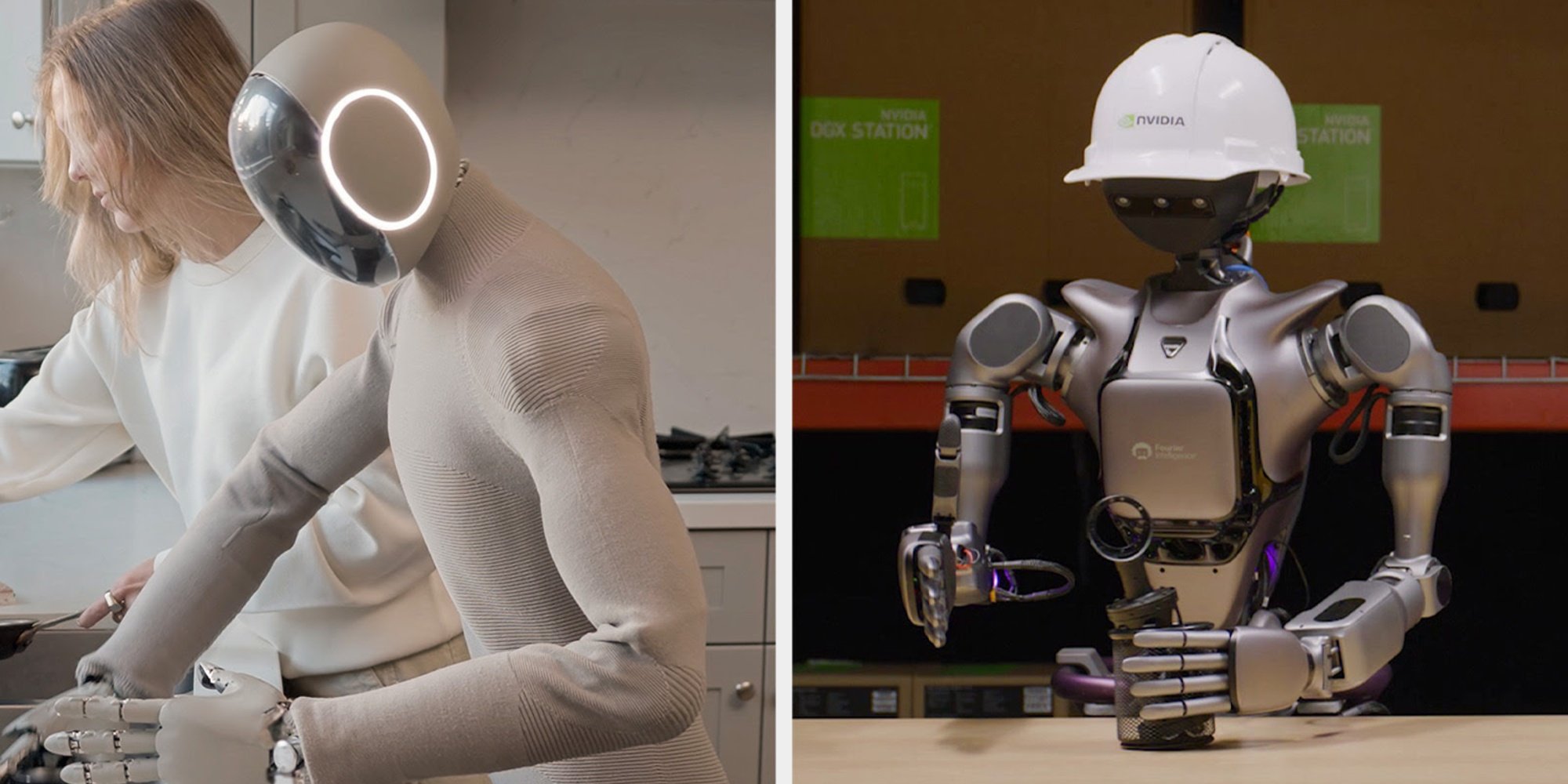
During its GTC 2025 event, NVIDIA unveiled a portfolio of technologies aimed at accelerating the development of humanoid robots. Among these innovations is Isaac GR00T N1, the first open-source and customizable foundation model, aimed at equipping robots with generalized reasoning capabilities and versatile skills, thus facilitating their adaptation to various tasks in diverse environments.
A new generation of humanoid robots
GR00T N1 marks a significant advancement in generalist robotics by enabling developers to equip humanoids with advanced reasoning capabilities. This model is based on a cognitive architecture inspired by human functioning, combining two systems:
- Vision-Language Model: This methodical thinking system is based on NVIDIA-Eagle with SmolLM-1.7B. It interprets the environment through vision and language instructions, allowing robots to reason about their environment and instructions, and plan the correct actions;
- Diffusion Transformer: This action model generates continuous actions to control the robot's movements, translating the action plan devised by the methodical thinking system into precise and continuous robot movements.
GR00T N1 has been trained on a large dataset, including human demonstrations and synthetic data generated by the NVIDIA Omniverse platform. This approach enables it to perform precise tasks such as grasping, object manipulation, as well as multi-step action sequences, with fluidity and precision.
NVIDIA has collaborated with leading companies such as Agility Robotics, Boston Dynamics, Mentoree Robotics, NEURA Robotics, and 1X Technologies, which had early access to GR00T N1. During the opening keynote, Jensen Huang, CEO of NVIDIA, and Bernt Børnich, CEO of 1X Technologies, demonstrated the model's capabilities with the NEO Gamma robot, which autonomously performed household tidying tasks.
An enhanced simulation and learning ecosystem
In parallel, NVIDIA announced several complementary technologies:
- Isaac GR00T Blueprint: A framework for generating synthetic motion data for training humanoid robots;
- Newton: An open-source physics engine developed in collaboration with Google DeepMind and Disney Research that will be available in 2025. Built on NVIDIA Warp, Newton is designed to optimize robot learning and will integrate with frameworks like MuJoCo;
- MuJoCo-Warp: A project resulting from collaboration between Google DeepMind and NVIDIA, aimed at accelerating robotic simulations by over 70 times.
These advancements enhance the potential of humanoid robots, particularly in industrial and entertainment applications. Disney Research plans to use Newton to develop more expressive robotic characters, akin to the Star Wars-inspired BDX droids.
Jensen Huang stated:
"The era of generalist robotics has arrived. With NVIDIA Isaac GR00T N1 and the new data generation and robotic learning frameworks, robotics developers worldwide will open the next frontier in the AI era."
The training data for GR00T N1 and task evaluation scenarios are available for download on Hugging Face and GitHub. The NVIDIA Isaac GR00T model for synthetic manipulation motion generation is also available as an interactive demo on build.nvidia.com or for download on GitHub.
Cet article publirédactionnel est publié dans le cadre d'une collaboration commerciale
To better understand
How does the Isaac GR00T N1 model differ from other robotic models in terms of cognitive architecture?
Isaac GR00T N1 employs a human-inspired cognitive architecture combining a Vision-Language model and a diffusion transformer to plan and generate actions, allowing it to interpret and act in various environments more human-like.
What are the regulatory challenges faced by advanced robotic technologies like those from NVIDIA?
Advanced robotic technologies, such as those developed by NVIDIA, must navigate a complex regulatory landscape where safety, privacy, and legal liability are major concerns. Regulatory frameworks need to evolve to integrate these innovations safely and ethically.