


Personnel management, employee well-being, and overall performance optimization are essential roles played by Human Resources (HR) in the functioning of companies. The second OpinionWay HR barometer conducted for Kelio highlights a complex picture where the growing adoption of AI and skepticism remain closely linked. The promise of efficiency that AI embodies in this sensitive field still faces challenges of trust, ethics, and technological maturity.
Rapid but Measured Adoption
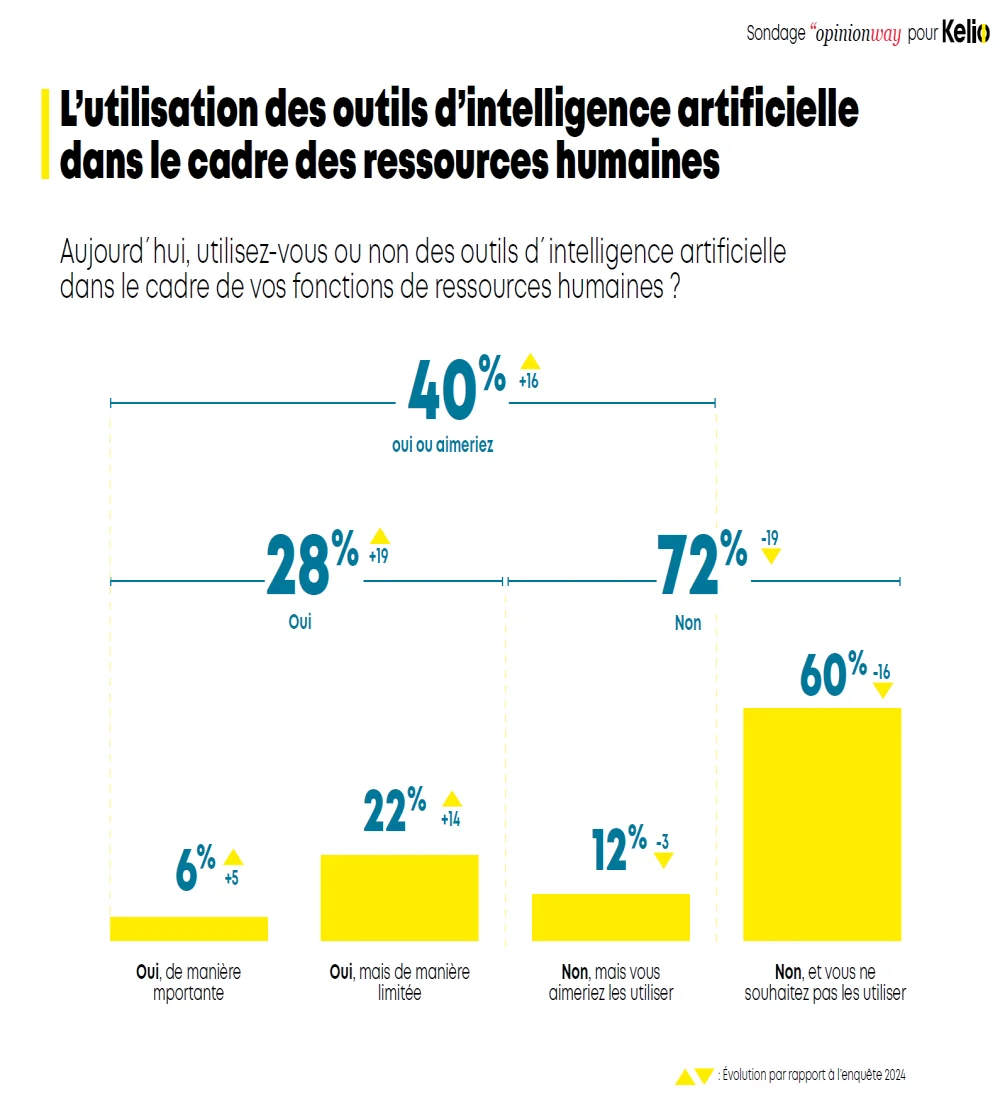
The survey, conducted last February and March, reveals that the use of AI by HR managers has tripled in one year: 28% of HR professionals report using AI daily in 2025, compared to only 9% in 2024. Specifically, 6% use it intensively (compared to 1% a year earlier) and 22% use it more occasionally, representing a 14-point increase.
However, a majority (60%) remains resistant to adopting AI, although this figure has decreased by 16 points in one year. This shift indicates a dynamic of adoption, particularly noticeable among medium-sized companies, where 34% of HR managers in this category use AI.
Persistent Doubts About Quality and Reliability
Another constant revealed by the barometer: trust in AI's capabilities remains limited. While 46% of professionals surveyed believe these tools can produce quality work, 54% remain skeptical, an unchanged figure compared to 2024. Despite this growing adoption, strong opinions are intensifying: 27% of respondents now express total distrust, an increase of 7 points.
This reservation reflects a lack of certainty about the reliability of the systems, a crucial issue when it comes to decisions related to human resources, where humans are at the core of the stakes.
Data confidentiality and security, which increased by three points, are now the main concerns for HR: 41% consider them priorities. Addressing these issues becomes a central criterion in AI adoption, especially as personal data management is increasingly scrutinized at both legislative and organizational levels.
Conversely, other barriers, such as tool incompatibility with internal processes, lack of skills, investment costs, or employee resistance to change, have significantly decreased.
Revolution or Simple Evolution of HR Tools?
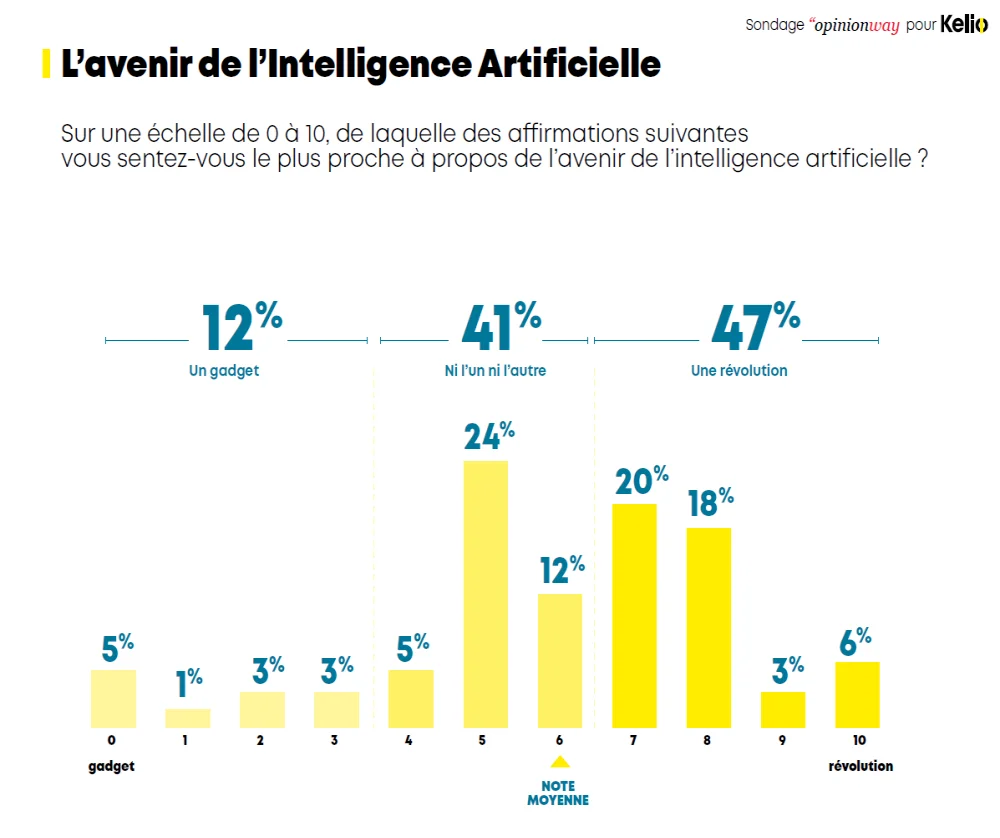
When asked about AI's long-term impact, HR professionals are divided. Nearly half (47%) see it as a potential revolution likely to transform their profession sustainably, a percentage that rises to 71% among convinced users. Conversely, 41% believe that AI does not yet constitute a major breakthrough or a marginal innovation. Finally, 12% still consider it merely a technological gadget.
AI as a Criterion for HR Software Selection
When AI is integrated into HR software, it is seen as an advantage by 49% of respondents (82% of regular users). However, a significant proportion of professionals (29%) consider AI a negligible element, with 15% even judging it prohibitive. Only 6% believe that the presence of AI is currently an essential criterion.
Although perceived positively by some professionals, AI is still regarded as a plus, but not an essential element across the entire sector.
Eric Ruty, General Director of Kelio, comments:
"AI is becoming widespread in the workplace and is already a valuable aid for HR professionals. However, they are essential safeguards against technological abuses that could impact humans or engage the legal responsibility of organizations. Their caution is thus legitimate towards tools that still need to prove their added value and reliability."
"AI is becoming widespread in the workplace and is already a valuable aid for HR professionals. However, they are essential safeguards against technological abuses that could impact humans or engage the legal responsibility of organizations. Their caution is thus legitimate towards tools that still need to prove their added value and reliability."
Translated from Ressources Humaines et IA : malgré une adoption en forte croissance, la méfiance reste de mise
To better understand
What are the underlying technologies that enable AI to transform the field of human resources?
Technologies such as Natural Language Processing (NLP), machine learning, and large-scale data analytics allow AI to transform HR by automating recruitment processes, analyzing employee performance, and predicting workforce needs.
What are the data protection regulations influencing the adoption of AI in human resources?
The General Data Protection Regulation (GDPR) in Europe imposes strict rules on managing personal data, influencing AI adoption due to the need for compliance with employee data privacy and security.