

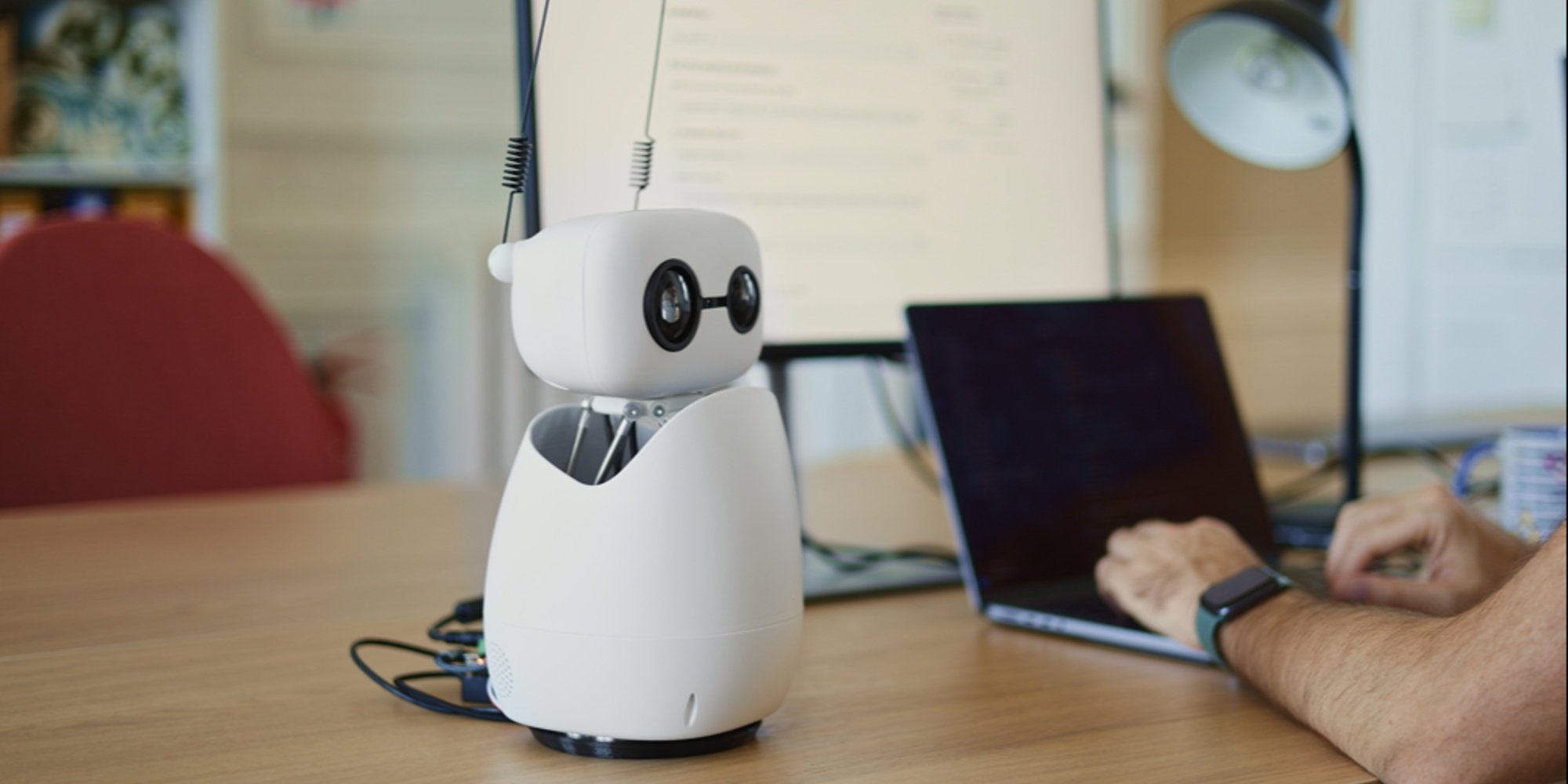
TLDR : Hugging Face introduces Reachy Mini, an affordable, open-source robot for AI and robotics experimentation, available in two versions starting at $299.
The Franco-American unicorn Hugging Face announces the pre-order availability of Reachy Mini, "an expressive and open-source robot designed for human-robot interaction, creative coding, and AI experimentation."
The renowned open-source collaborative platform aims to democratize not only AI but also robotics. Having launched the LeRobot library in 2024, led by Rémi Cadene, a former engineer from Tesla's Optimus program, it acquired Pollen Robotics last April.
Founded in 2016 by Matthieu Lapeyre and Pierre Rouanet, both former members of the INRIA Bordeaux Flowers team that created the 3D printed, open-source humanoid robot Poppy for education and research, this company joined the "AI Startup Program," a joint initiative by Hugging Face, Meta, and Scaleway.
Selected for its open-source humanoid platform Reachy, the Bordeaux-based startup later collaborated with Hugging Face on Reachy 2. This lab assistant, priced around $70,000, has been adopted by prestigious institutions such as Cornell University, Carnegie Mellon, École Polytechnique, CEA, and CNRS, where it is used to explore human-robot interaction, machine learning, and virtual reality teleoperation.
Reachy Mini: A Tool to Learn, Create, and Share
"Low price, small size, big possibilities": this is how Hugging Face presents Reachy Mini, its new open-source robot designed by Pollen Robotics, which is much more affordable. With it, the unicorn aims to open a new chapter in the history of personal and educational robotics.
Programmable in Python, and soon in JavaScript and Scratch, Reachy Mini is primarily an experimentation platform. Compact (28 cm tall and 16 cm wide) and lightweight (1.5 kg), this small desktop computer allows for the development, testing, deployment, and sharing of AI applications. It is aimed at developers, researchers, educators, and beginners alike.
Equipped with two animated antennas, a wide-angle camera, and a 5W speaker, it can rotate on itself and turn its head (6-degree rotation angle). Each of its eyes contains a small screen that allows for the display of pupil movements, blinks, or reactions based on programmed behaviors. This visual expressiveness enhances human-machine interaction and facilitates the adoption of the robot in educational or experimental contexts.
It is offered in two versions:
- Reachy Mini Lite, at $299, requires a USB connection to a computer, compatible with Mac and Linux (soon Windows), and has 2 microphones;
- Reachy Mini, at $449, is fully autonomous, with an embedded Raspberry Pi 5 mini-computer, four microphones, an accelerometer, a rechargeable battery, and a Wi-Fi connection for wireless use.
True to Hugging Face's open-source DNA, Reachy Mini is entirely open, both in hardware and software. The platform provides users with a whole ecosystem to create and experiment: a Python SDK to program the robot and interact with its sensors and motors, a software simulator to test behaviors in a virtual environment even before the robot's arrival, and direct access to AI models hosted on the Hugging Face Hub and Spaces.
Both versions will be delivered as self-assembly kits: Reachy Mini Lite will be available by the end of this summer, while the autonomous model will be deployed in batches between this fall and throughout 2026.