

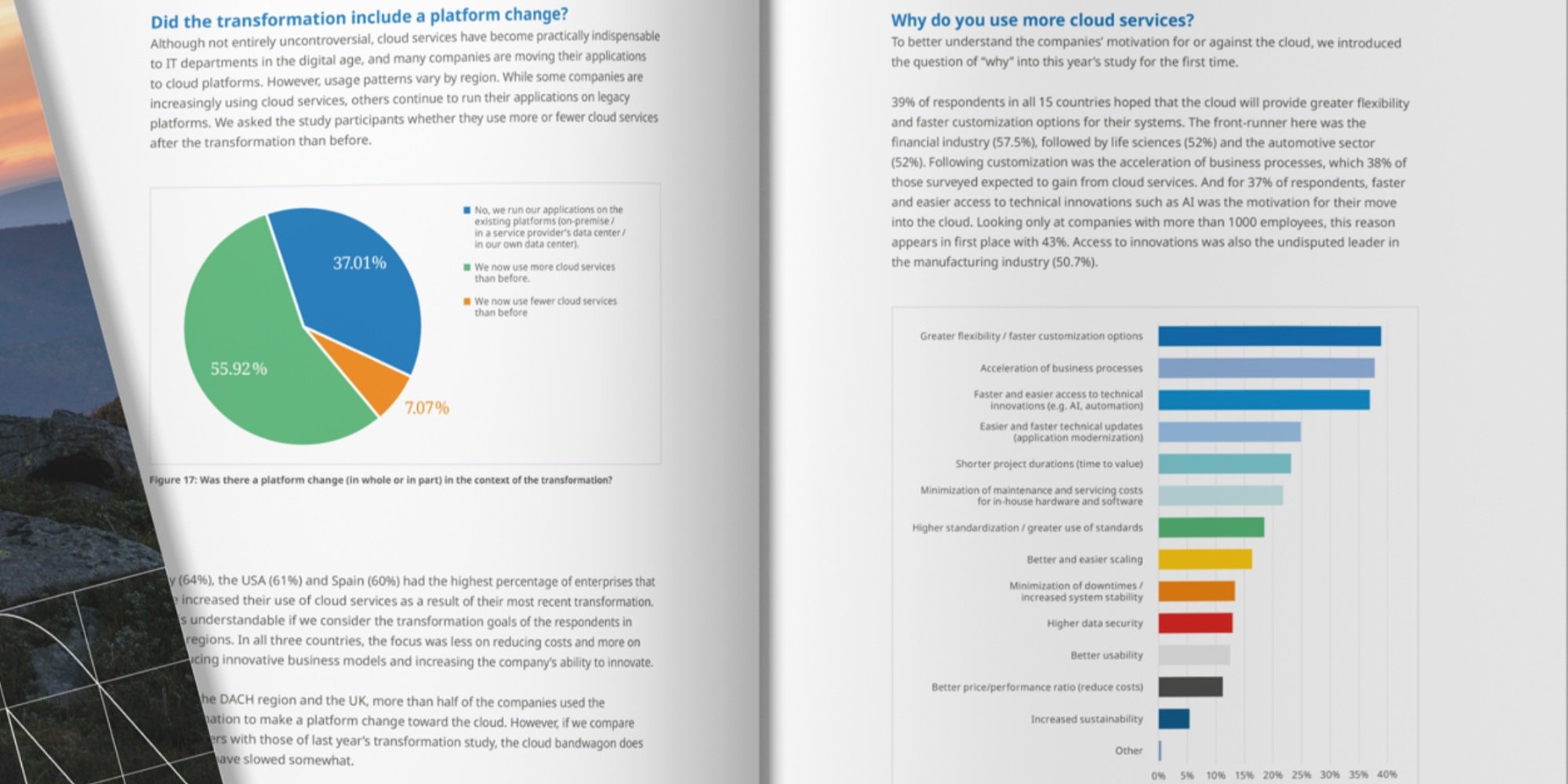
The global study “Transformation 2025” by NTT DATA Business Solutions and Natuvion is based on the testimonies of 909 CEOs, CIOs, and IT managers who have embarked on digital transformation projects, whether ongoing or completed. While AI has now become the key component of these projects, a carefully planned strategy, adapted skills, and coordination between different departments are essential for implementation.
Digital transformation projects are no longer just the business of the IT department. In France, they are primarily driven by executive management (37%) and the board of directors (36%), relegating IT to the third place (33%). Digital is no longer just a technological issue but is now at the heart of strategic decision-making.
The rise of artificial intelligence in priorities (cited by 57% of leaders compared to 25% in 2024) intensifies this tension. This increase reflects a desire to make AI a lever for global transformation, going well beyond cost optimization, to fundamentally rethink the offering, innovation, and customer experience. Nearly 90% of companies are actively preparing for this, both technologically and organizationally.
Extended Timelines, Underestimated Budgets
Digital transformation projects struggle to meet budget and time constraints. More than 82% of surveyed companies reported exceeding their initial budget. In terms of schedule, the discrepancies are equally stark: 45% of projects experienced a delay of at least 20%, and nearly a quarter exceeded forecasts by more than 30%. France leads these overages above 30%, ahead of Eastern Europe and the United States.
These figures do not reflect the failure of the projects undertaken; on the contrary, nearly 90% of respondents believe that the delays in go-live were beneficial, providing the necessary time to consolidate processes.
Beyond the skills shortage and inflation, the cost of transformation is increasing, partly due to the expansion of project scopes and increasing technological pressure. The invested amounts reflect this reality: 52.5% of companies have committed between 2 and 20 million euros, and nearly a fifth have exceeded the 20 million mark. Among large companies (turnover > 1 billion euros), the budget can exceed 50 million euros.
The Human Factor: An Essential Success Factor
An essential lesson from the study is the redefinition of success criteria. While AI is the most mobilized technology, the determining factors are primarily human: team continuity is identified as the main success factor (33%), even ahead of skills or technological choices. Inter-departmental communication, often relegated to the background, is cited as an improvement point by 35.2% of companies that regret not having sufficiently cared for their communication flows.
This observation reminds us that AI projects cannot do without collective dynamics: data quality depends on the maturity of processes, algorithm efficiency on the clarity of use cases, and employee engagement on the pedagogy of change.
Hans Kourimsky, CEO of NTT DATA Business Solutions France, summarizes this triple imperative:
"AI is the engine, data is the fuel, but the drivers remain human beings."
concluding:
"A forward-looking direction today means, more than ever, thinking about humans and helping them advance in change, aided by technology, but based on a clear vision and defined objectives."
Complete study here.