


TLDR : Faced with the massive increase in data and regulations like the GDPR, French companies see compliance not just as a legal constraint but as a lever for competitive differentiation. However, data quality remains a barrier to AI adoption, despite growing momentum towards this technology.
Table of contents
As data volumes reach staggering heights, French companies face a significant challenge: maintaining compliance with ever-evolving and more demanding regulations. A recent study conducted by OnePoll for Splunk, surveying 500 IT decision-makers from companies with over 250 employees, highlights the tensions and drivers reshaping the data function.
Compliance Amidst Accelerating Data Volumes
Maintaining compliance is becoming increasingly complex. While 53% of French organizations struggled to stay compliant over the past three years, this figure has now risen to 56%, primarily due to the massive growth in data within a regulatory environment shaped by the GDPR, the AI Act, and the NIS2 directive. These regulatory frameworks, designed to ensure the ethical and secure use of digital technologies, are putting increasing pressure on IT departments.
The challenge is not only legal: 63% of respondents anticipate a risk of financial penalties for non-compliance, while 69% identify GDPR as the main source of complexity. The ongoing European regulatory simplification effort has not yet altered perceptions on the ground: 61% of companies believe compliance will become more difficult in the next three years.
An Alignment Between Compliance and Performance
Beyond being a constraint, compliance is emerging as a strategic structuring vector: 71% of IT decision-makers see it as a lever for competitive differentiation. Regulatory frameworks act as a catalyst for better data governance, a prerequisite for controlled innovation.
Improving the speed of innovation (36%) and responsiveness to market changes (34%) are cited among the expected benefits of more effective data management. In this context, the regulatory framework becomes an engine for internal transformation, contributing to the alignment of information systems and operational processes.
An Acceleration in AI Adoption, Yet Hampered by Data
France is progressively catching up in AI adoption: 70% of surveyed companies are currently working on AI projects, a rate now close to those observed in the UK (71%) or Germany (75%). However, this momentum is still marked by less experience in operational deployment: only 39% of respondents combine past and ongoing projects, compared to 53% in the UK.
Data quality is a significant barrier to AI adoption: 42% of respondents point to outdated or incomplete datasets that could slow down projects. Meanwhile, the introduction of AI solutions itself generates new volumes to be processed, considered problematic by 45% of IT decision-makers. The resulting data overload threatens operational efficiency for 59% of them.
Towards Greater Data Governance Maturity
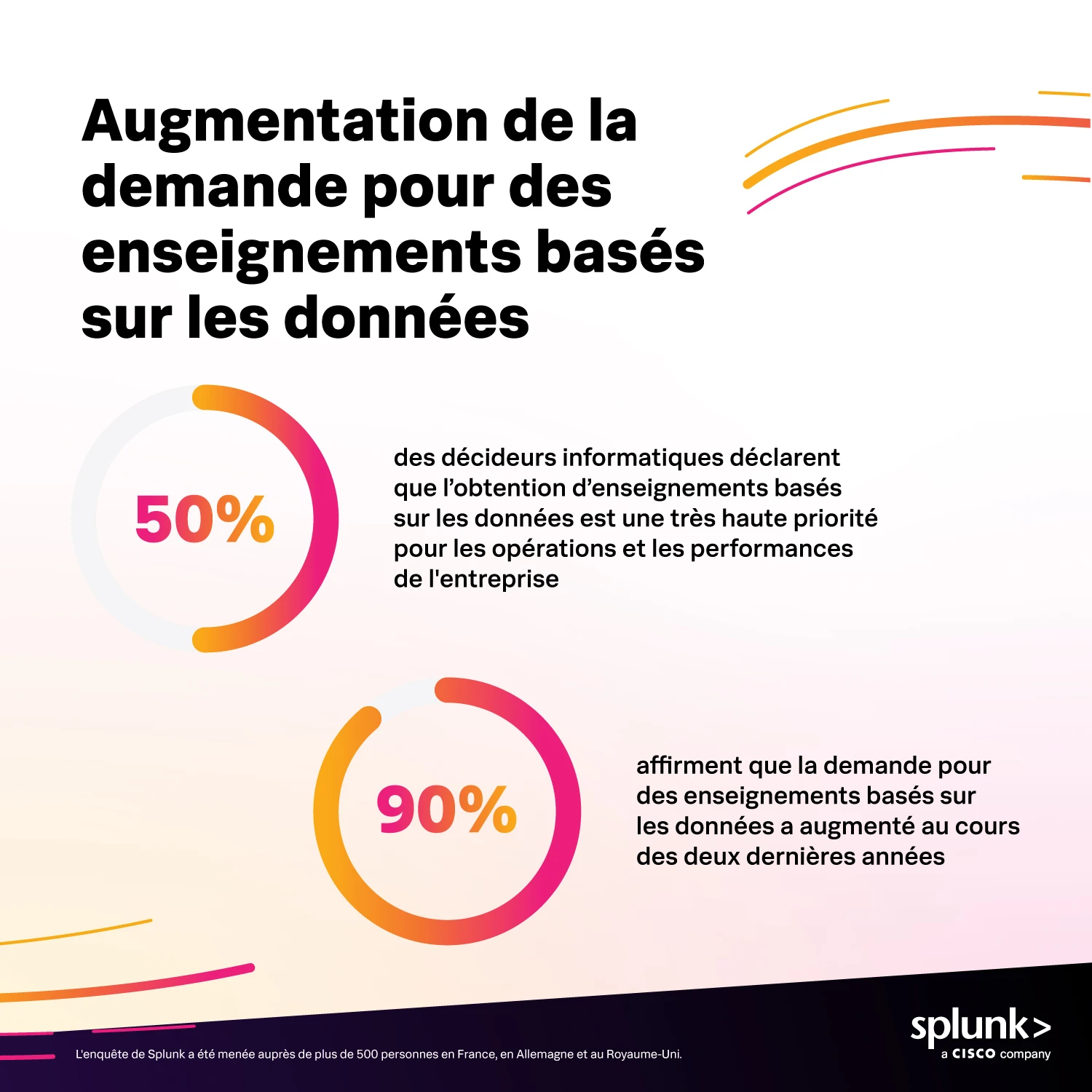
The study reveals a growing awareness of strategic data-driven management issues: 52% of IT decision-makers indicate that their boards now expect data-driven insights, particularly in a context of technological transformation and competitive intensification. Data becomes a management asset, not just a flow to regulate.
Among those who have seen their data volumes increase, 22% view it as an opportunity for innovation, particularly through the development of new products or services. Data governance is thus redefined as an organizational capability to capture, secure, and exploit information, serving resilience and growth.
A Trajectory Built on Structuring and Discipline
In a context marked by macroeconomic instability and regulatory intensity, the ability to articulate rigorous data management, technological adoption, and compliance becomes a pillar of stability and value creation. French companies, historically cautious in their approaches, are now adopting a more assertive stance, marked by targeted investments and increased attention to data governance.
Petra Jenner, General Manager & Senior Vice President EMEA at Splunk, comments:
"Data is the cornerstone of innovative and resilient companies. Only good data management will allow them to access the right data, at the right time, to maintain a high level of compliance and innovation, for example, with AI solutions. Continuous investments are necessary to ensure organizations have the tools and skills needed to manage increasingly large data volumes. It is very encouraging to see that France seems to be catching up in AI deployment. French companies have distinguished themselves so far by their pragmatism and caution; but 2025 is indeed the year where the ROI of this technology is no longer in question!"