

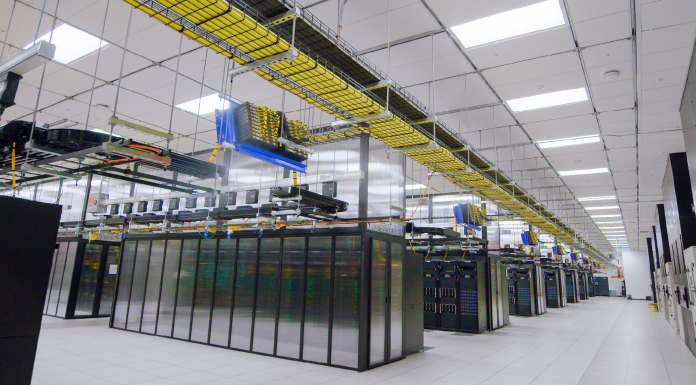
Facebook founder and Meta CEO Mark Zuckerberg announced on Monday, Jan. 24, the construction of the AI Research SuperCluster (RSC) supercomputer, which is among the fastest AI supercomputers today and is expected to be the fastest by mid-2022, when it is finalized. Researchers are already using it to train large models in natural language processing (NLP) and computer vision. RSC will enable the creation of technologies for the metaverse, the next big computing platform where AI-driven applications and products will play an important role.
The first computers appeared in the 1960s and were first used for scientific research. Since then, their power has continued to increase and their computing capacity is now measured in exaflops (more than a billion billion operations per second). The United States, China, Japan and Europe are in the race for exaflops computers, with world technological domination at stake. RSC will allow Meta to make a name for itself in the field of metavers, an ambition clearly stated when Facebook changed its name to Meta:
"Meta's goal will be to bring the metaverse to life and help people connect, find communities and build businesses."Mark Zuckerberg elaborates on RSC:
"The experiments we're creating for the metaverse require enormous computing power (quintillion operations per second!) and RSC will enable new AI models that can learn from trillions of examples, understand hundreds of languages, and more."
The Research SuperCluster supercomputer
The supercomputer will allow Meta to leverage data from its various platforms, (Facebook, Messenger, Instagram...) to train AI engines, particularly in the area of language or image processing. It will replace Meta's infrastructure designed in 2017, which has 22,000 Nvidia V100 Tensor Core GPUs and performs 35,000 training tasks per day."While our previous AI research infrastructure only used open access data and other publicly available datasets [RSC will] enable the use of real world examples'' from Meta's platforms."He also assured:
"This is the first time that performance, reliability, security, and privacy have been considered on such a large scale."